

Technology use from seed to sale
How AI and software are improving visibility, yields and efficiency in greenhouses. Learn how growers are using it.





REALIZING A NEED
Founded in 2000 by Aaron Allison and Tim Mortia, SBI Software began with the purpose of helping growers fully integrate enterprise systems for retail suppliers and growers. This software offers a solution to operation aspects including forecasting, production and replenishment, as well as growing, inventory, order processing and shipping steps.“We cure inventory visibility by getting availability visible to the right people. We do it with less daily labor than any other system on the market,” Allison said.
Rein Kamman and Ernst van Bruggen founded Source. ag in 2020 with the goal of creating a software and AI company to provide tools to large- scale greenhouse operators growing tomatoes, peppers or cucumbers.
“We have pioneered the use of applied AI to create digital For planning, Harvest Forecast is used to generate precise yield forecasts up to eight weeks. Photo courtesy of Source.ag. representations of greenhouses and crops, enabling growers to simulate plant behavior, optimize strategies and predict yields up to eight weeks ahead,” said Tomas Geurts, general manager, North America for Source.ag.
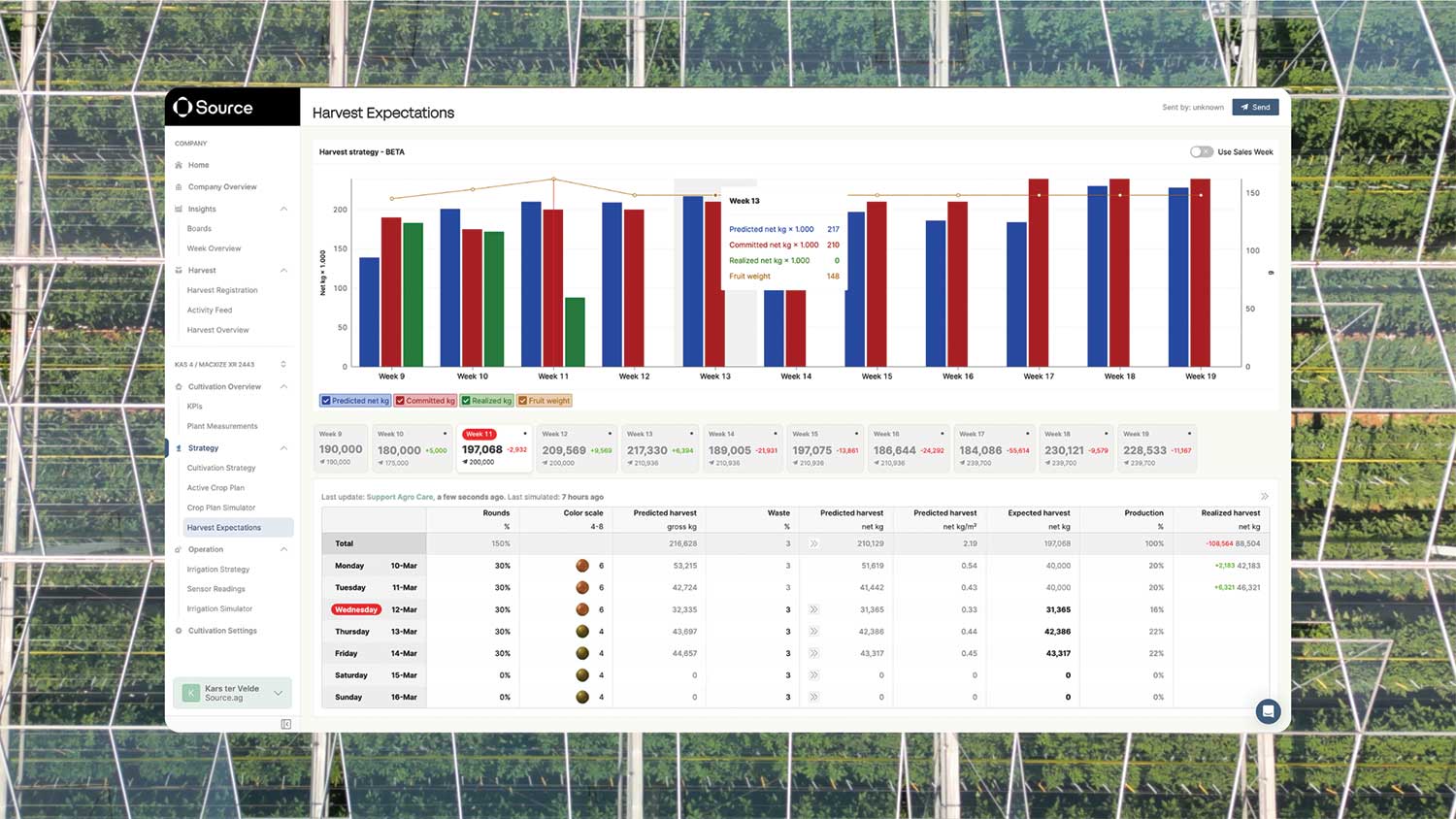
For planning, Harvest Forecast is used to generate precise yield forecasts up to eight weeks. Photo courtesy of Source.ag.
AI CAN AID GROWERS NEEDS
According to Geurts, these technologies are designed to address operational blind spots, eliminate risk and inconsistency, and tackle strategic challenges that can limit greenhouse scalability and profitability.Geurts said that “data centralization and visualization is handled by Source Workspace, via Source Cloud, which collects and unifies all data for complete performance tracking.”
For planning, Harvest Forecast is used to generate precise yield forecasts up to eight weeks, which are updated daily based on real- time cultivation and crop changes, weather forecasts and strategy.
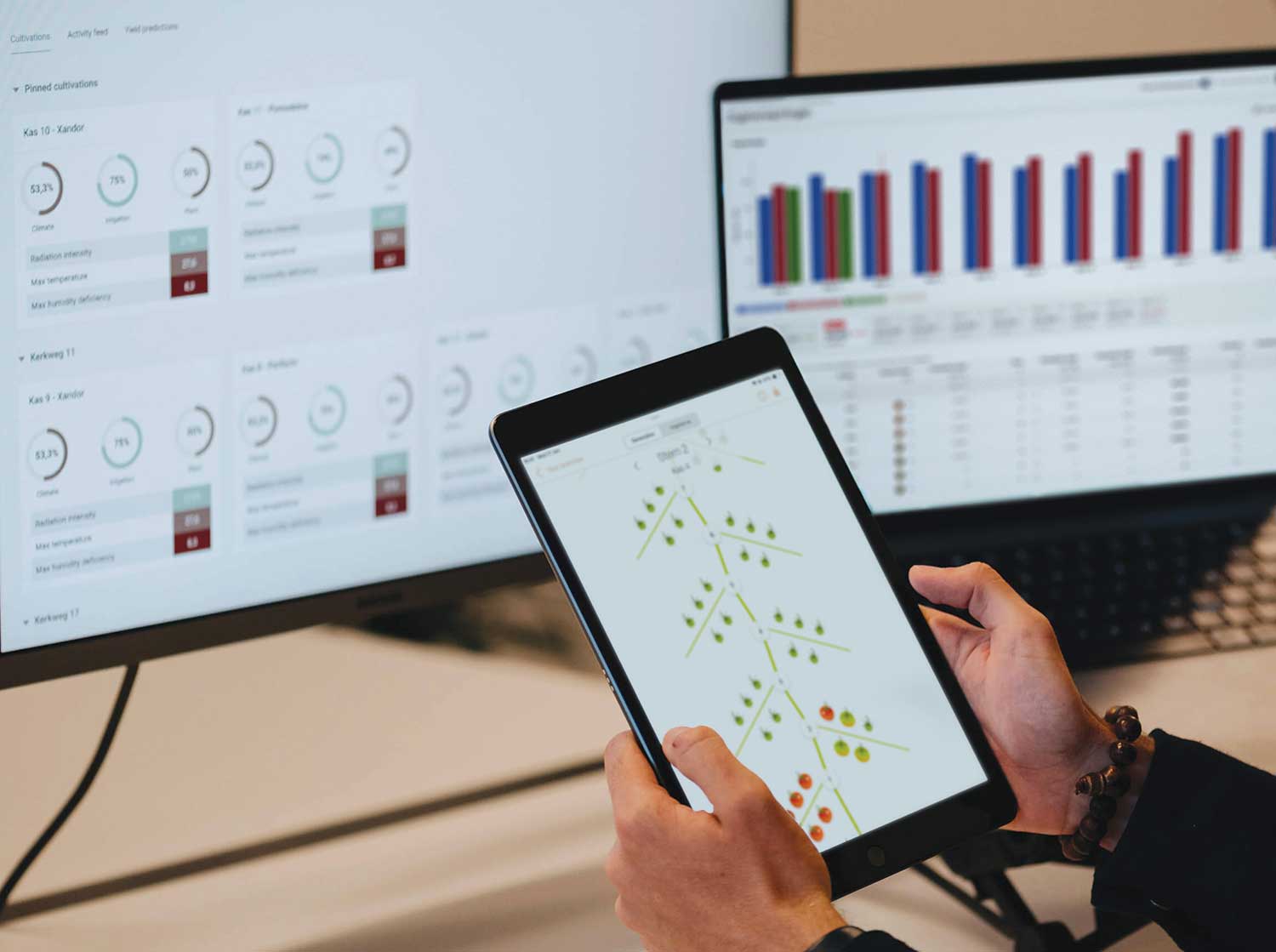
Data centralization and visualization is handled by Source Workspace and unifies data for complete performance tracking. Photo courtesy of Misses Prins.
For strategic management, Cultivation Management can be used to simulate the measurable impact of strategic decisions on crop development.
“Finally, for execution, Source Irrigation Control handles the Data centralization and visualization is handled by Source Workspace and unifies data for complete performance tracking. Photo courtesy of Misses Prins. fully autonomous calculation and delivery of optimal water and nutrient strategies, ensuring critical physiological targets, like dry-down, are consistently met,” Geurts said.
Similarly, SBI Software offers applications for growing and inventory, production planning, order processing and shipping, financial management, and analytics and reporting.
SBI has a desktop and mobile app to handle needs including order fulfillment, availability, scouting and production work orders. The software also includes a merchandiser app for retail and a drivers app for deliveries, Allison said.
SBI continues to remain user- friendly by creating office and mobile tools to help growers such as the Flow app. “It’s a field app for mobile users to match any workflow, which runs completely offline so the user needs no connectivity. It can also query things live when required in the app,” Allison said.


SOLUTIONS FOR A SMARTER GREENHOUSE
Efficiency can also help improve operations. The main difference between using this technology compared to traditional manual processes is improving visibility and communication between the entire team, Allison said.“We see growers getting 70% of annual sales in the very first year of using our online orders system,” he said.
“Our growers achieve higher yields and better plant balance because they can always find the optimal growing strategy through our crop plan simulator and execute it with our autonomous control solutions,” Geurts said.
Furthermore, procurement and sales teams can achieve better pricing through improved prediction accuracy and increased foresight, allowing them to secure better contracts to directly improve the topline.
“And autonomous irrigation control can save growers up to 80% of the time they spend managing their irrigation and fertigation systems while leading to a healthier rootzone by consistently achieving drain and dry-down targets,” Geurts said.
INNOVATION AND INDUSTRY TRENDS
The technology created at SBI is driven by its clients and the industry, continually innovating to create advanced production software for growers around the country, Allison said. “Its horticulture software designed to support nursery and greenhouse operations with precision. We are using AI to create new orders based on variables only AI could be capable of reviewing,” he said.“Automation and AI are fundamentally transforming the grower’s role from a hands-on operator to a data analyst and strategic manager,” Geurts said. “AI can take over the larger, repetitive and tactical day-to-day decisions, like irrigation adjustments. This elevates the grower to a strategic role focused on validating cultivation strategies in the virtual environment, analyzing exceptions flagged by the AI, and driving long-term, scalable process improvement,” he said.
MISCONCEPTIONS ABOUT AUTOMATION
Traditional misconceptions about AI need to be overcome in order for growers to adopt the technologies, the company founders said.“The most common and persistent misconception we encounter is that AI is here to replace the grower,” Geurts said. “This is absolutely not the case; it digitizes the best human knowledge and experience, scales it and handles the operational complexity in a critical way. AI needs human input. It is only as good as the data and the initial, high-level strategies it is given.
“The human grower’s experience remains critical for setting the goals, validating the AI’s recommendations and handling unforeseen biological or technical anomalies.”
CHALLENGES AHEAD
Various challenges to widespread adoption of technological advancement lie ahead.“Wider adoption always involves navigating new challenges, which we see as exciting areas for innovation and partnership. Right now, our AI solutions are constantly learning and improving, driven by the high-quality data input we receive from the field. We are focused on continuous refinement, as we are constantly working to find workarounds for extreme outliers,” Geurts said.
“Over the last 25 years customers have become way more willing to adopt technology and change to improve their businesses. The hardest part is human adoption by the team; technical challenges are not as difficult as the human side,” Allison said.
Gabrielle Rippel is a freelance writer with experience in multiple industries. Check out her recent work at getagrippel.com.