

Become a Certified Horticulture Professional as Part of Your Professional Brand





Architects. Bankers. Nurses. Accountants. Engineers. Agronomists. Auto mechanics. What do all of these professions have in common? All of them (along with many other professions) have certification programs that provide professionals in their disciplines opportunities to earn certifications, designating and assuring the public that an individual is qualified to conduct or perform their job. [Architects (e.g., LEED), auto mechanics (e.g., ASE), bankers (e.g., CTFA; CRSP), nurses (e.g., NP, CNS), accountants (e.g., CPA, CMA), engineers (e.g., PE) agronomists (e.g., CCA, CPAg)].
In our daily lives, as consumers and business professionals, we interact with and hire professionals from many different fields. We rely on their expertise and trust their advice and service, both in our professional and personal lives. But how does one know which company or professional is reliable and trustworthy to do the job or service right?
While it may or may not be obligatory for individuals of a specific profession to obtain certifications in order to do business, individuals in many professional fields acquire certification to enhance their ability to gain customer respect and trust, document their expertise, and ultimately attract new clientele. Many professionals even find it valuable to hold multiple certifications.
Did you know that the American Society for Horticultural Sciences (ASHS) offers a national certification program for you and the horticulture industry? This program is designed for anyone involved in the production, sales, marketing and use of horticultural plant material and products including growers, suppliers, greenhouses, nurseries, garden centers, landscapers, vegetable and fruit producers and allied trades.
Who is ASHS?
ASHS is the world’s premier professional society for horticultural science, somewhat analogous to the American Society for Civil Engineers or the American Medical Association. Horticulture is the science and art of producing, improving, marketing, and using fruits, vegetables, flowers, and ornamental plants. It differs from botany and other plant sciences in that horticulture incorporates both science and aesthetics. Learn more about ASHS at www.ashs.org.ASHS development of the certified professional horticulture program originated in 1976, at the annual ASHS meeting and was finally implemented at the annual meeting some 15 years later. Initially, the certification program was administered through the Federation of Certifying Boards in Agriculture, Biology, Earth, and Environmental Sciences. In 2000, full control of the certification program was moved under the auspices of ASHS. More recently, several dedicated ASHS members developed the certified horticulturist program, which was implemented in 2008.
ASHS Certification Programs
Three national certification programs are offered by ASHS to horticulturists and professionals working in the horticulture industry with a major goal of recognizing competent individuals in their various fields and to increase professional standing and visibility of Horticulture as a profession and career.The horticulture certification provides employers and consumers alike with the knowledge that the person they are hiring or contracting with is someone who is knowledgeable in the field and adheres to ethical practices. The three certification programs offered through ASHS are: Certified Professional Horticulturist (CPH), Associate Professional Horticulturist (APH) and Certified Horticulturist (CH).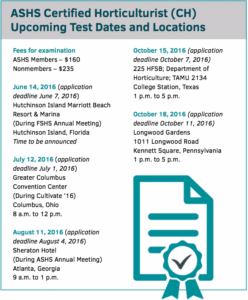
Certified Professional Horticulturist. The CPH program, the highest certification level offered by ASHS, recognizes horticulturists employed in the industry, scientific, education and service sectors, in both the public and private sectors; who have significant work experience, have established themselves in the industry, adhere to ethical practices and have a minimum education of a Bachelor of Science degree in horticulture or a closely related field. As a CPH, one may be solicited to consult or advise horticulture ventures, both public and private, advise elected officials, provide legal testimony, and provide appropriate information to the media. To be a CPH, the applicant must have a bachelor’s degree and five years work experience; while individuals with an advanced degree must have at least three years work experience.
The complete application process to become a CPH is available on the ASHS web site. After submitting an application, the National ASHS Certification Board reviews and assesses an applicant’s credentials including education or academic qualifications, professional experience, and professional references in order to determine if the applicant meets the qualifications. Currently this certification is based on credentials and no exam is required. All certified individuals must acquire and document continuing education units to retain their certification.
Chad Miller, CPH, is an assistant professor of ornamental horticulture at Kansas State University and a member of the ASHS National Certification Board. He can be reached at ctmiller@ksu.edu.