

Dr Bugs: Antipredator behaviors of thrips
Thrips species resist predatory mites through feeding, defense behaviors and life stage traits. Learn key factors and evaluate control strategies.





Question: I’ve read that some commercially available predatory mites don’t effectively control certain thrips species. Why is this?
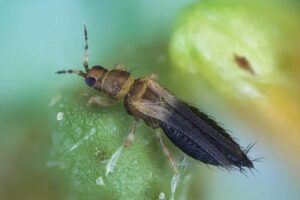
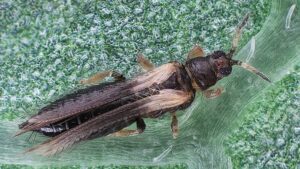
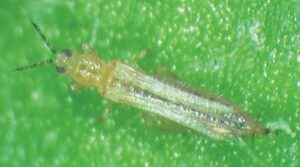
Answer: There have been challenges associated with using commercially available biological control agents (BCAs) — particularly predatory mites — to keep pepper thrips, Thrips parvispinus (Figure 1), and poinsettia thrips, Echinothrips americanus (Figure 2), below levels that cause plant damage. This raises an important question: Why are pepper thrips, poinsettia thrips and even Western flower thrips, Frankliniella occidentalis (Figure 3), less susceptible to predatory mites such as Neoseiulus cucumeris, Neoseiulus californicus and Amblyseius swirskii?
The reason may be due to the antipredator behaviors of thrips, which include consuming predatory mite eggs, hitting predatory mites with their abdomens, covering predatory mites with anal droplets of alarm pheromones and/or hiding from predatory mites on plants.
The second instar larvae and adults of Western flower thrips, and first and second instar larvae of the pepper thrips, feed on the eggs of predatory mites. Predatory mite eggs may serve as a source of nitrogen for thrips, which is essential for development and survival.
For example, Western flower thrips adults feed on twospotted spider mite eggs, Tetranychus urticae, as a source of nitrogen. This would reduce predatory mite populations and decrease the ability to keep thrips populations below plant-damaging levels. However, the larvae and adults of poinsettia thrips do not feed on predatory mite eggs.
Adult thrips are generally less susceptible to predation because they can actively defend themselves. Species such as Western flower thrips, pepper thrips and poinsettia thrips use rapid sideways movements of their abdomen to strike predatory mites, reducing the mites’ ability to attack successfully.
Western flower thrips and pepper thrips produce anal droplets at the tip of their abdomen that deter predatory mites. When mites are coated by these droplets, they stop attacking and spend time grooming themselves, allowing the thrips to escape and reducing their susceptibility to predation.
In addition, anal droplets may contain alarm pheromones (e.g., decyl acetate and dodecyl acetate) that warn members of the same thrips species. As a result, other thrips are induced to move away, fall off plants or hide in concealed areas on plants to escape predation.
However, poinsettia thrips adults do not produce anal droplets when they encounter predatory mites.
Additional reasons why predatory mites do not attack certain life stages of thrips are:
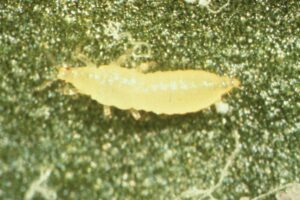
1. The exoskeleton (skin) of second instar larvae (Figure 4) is too difficult to penetrate with the mites’ mouthparts.
2. The quality of second instar larvae as a food source is lower than that of first instar larvae.
3. Predatory mites avoid second instar larvae and adults because of the risk of physical damage due to being hit by the abdomen and the subsequent time required to clean/groom themselves after exposure to anal droplets.
4. The size of thrips larvae may influence susceptibility to attack, which may be why first instar larvae are mostly fed upon by predatory mites.
However, first instar larvae of poinsettia thrips are not fed upon by predatory mites, including Amblyseius swirskii.
In conclusion, understanding the antipredator behaviors of thrips can help growers make more effective biological Figure 4. Second instar larva of Western flower thrips control decisions. Because these behaviors influence how well predatory mites perform, accurately identifying the thrips species is an important first step in determining whether predatory mites are a suitable and effective option for keeping populations below plant-damaging levels.
Raymond A. Cloyd is professor and Extension specialist in horticultural entomology/plant protection at Kansas State University. He can be reached at rcloyd@ksu.edu.