

Dr. Bugs: Life cycles of insect and mite pests
Life cycle is the progression or series of changes that an individual insect or mite pest goes through from egg to adult.





So, what does life cycle mean? Life cycle is the progression or series of changes that an individual insect or mite pest goes through from egg to adult. Another term associated with life cycle is metamorphosis, which is a change in body form as a pest develops.
METAMORPHOSIS
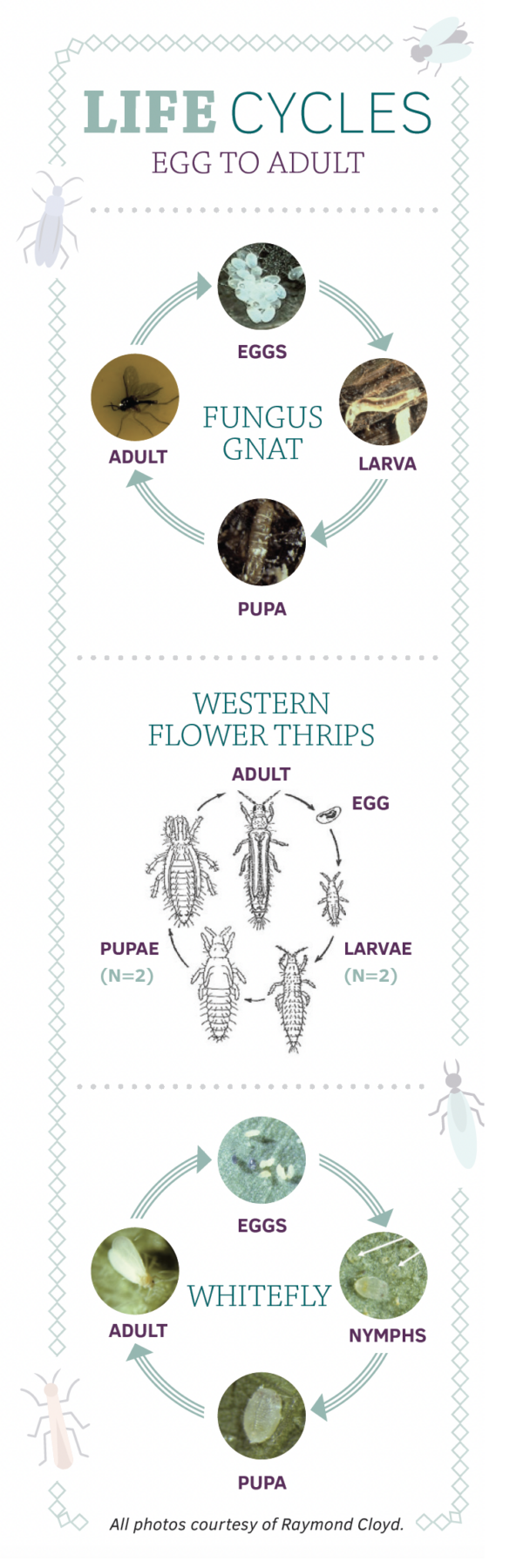
All photos courtesy of Raymond Cloyd.
There are two types of metamorphosis: incomplete/gradual and complete. Incomplete/gradual metamorphosis involves three life stages: egg, nymph and adult. During development, the nymph undergoes a process called molting, in which the old skin or cuticle is shed several times before becoming an adult. Instar is a term indicating the stage between each molt.
Examples of greenhouse insect and mite pests that undergo incomplete/gradual metamorphosis are leafhoppers and mealybugs. There are no eggs associated with aphids in greenhouses because the female produces live nymphs. The twospotted spider mite (Tetranychus urticae) has four life stages: egg, six-legged larva, eight-legged nymph and adult.
Complete metamorphosis involves four life stages: egg, larva, pupa and adult. Like the nymph associated with incomplete/gradual metamorphosis, the larva in complete metamorphosis undergoes a molting process. Examples of greenhouse insect pests that undergo complete metamorphosis include fungus gnats, leafminers, shore flies, thrips and whiteflies. In general, the larva and adult feed on different food sources. In addition, the adults, in most cases, do not cause plant damage with the exception of thrips and whiteflies.
LENGTH OF LIFE CYCLE
The length of each life stage depends on the pest and environmental conditions, such as temperature. Insect and mite pests are cold blooded (having a body temperature that varies with the environment).Consequently, they respond favorably to warm temperatures, which reduces the time required to complete all life stages within a life cycle, which is called a generation. The life cycle is completed sooner when temperatures are greater than 75° F compared to when temperatures are less than 50° F.
PEST MANAGEMENT
Not all life stages of pests feed on plants. For example, the egg and pupa do not feed on plants. In addition, not all life stages are susceptible to pesticides (insecticides and miticides) or biological control agents, such as parasitoids and predators.For instance, the egg and pupal life stages are less susceptible to pesticides than the larva, nymph and adult life stages of pests. Consequently, pesticides should be applied when the larva, nymph and adult life stages are present. Some biological control agents only feed on or attack certain life stages of an insect pest.
For instance, predatory mite Neoseiulus cucumeris only feeds on the first instar larva of the Western flower thrips (Frankliniella occidentalis). Female Encarsia formosa (a parasitoid of the greenhouse whitefly, Trialeurodes vaporariorum) prefers to lay eggs in third and fourth instar larva. Female Eretmocerus eremicus (a parasitoid of the sweetpotato whitefly, Bemisia tabaci) favors third and fourth instar larvae to lay eggs.
Understanding the life cycle of insect and mite pests will allow you to time pesticide (insecticide and miticide) applications or releases of biological control agents when the most susceptible life stages are present. In turn, this allows you to maintain insect and/or mite pest populations below plant damaging levels so you can produce a marketable/salable crop.
Raymond A. Cloyd is professor and Extension specialist in horticultural entomology/plant protection at Kansas State University. He can be reached at rcloyd@ksu.edu.