

Turning Sustainability Aspirations into Sustainable Value for Growers





Ask the Expert: Growscape
(Sponsored) Sustainability has evolved from a marketing strategy into a fundamental part of managing risk and running a successful business. From recycling infrastructure to ever changing regulations, growers are looking for practical solutions that reduce complexity while supporting measurable environmental progress.

Tom Marting, Director of Sustainable Solutions at Growscape, says the industry conversation has become far more focused on turning sustainability into tangible value.
Q: How has the conversation around sustainability changed for growers in recent years?
A few years ago, the focus was largely on ambitious long-term goals and commitments. Today, growers are being asked to deliver measurable results on much shorter timelines. The conversation has shifted from aspiration to execution.
Growers are balancing labor shortages, freight costs, and evolving retailer expectations, so sustainability solutions must fit into daily operations. Sustainability done right should support both environmental progress and business performance.
Q: What is the EarthSafe platform, and why did Growscape develop it?
EarthSafe is our integrated sustainability platform built around three pillars: ReSource Recycling, ReTerra plantable bioplastic, and ReAssure regulatory compliance support.
We designed it to connect sustainability efforts that were often treated as separate initiatives. When recycling, materials innovation, and compliance strategies work together, growers can reduce risk while improving operational efficiency.
Q: Recycling continues to be a major industry topic. How is Growscape approaching it differently?
Through our ReSource Recycling program, we’ve expanded beyond plastics to support corrugate, paper, glass, pallets, and metal because growers manage multiple waste streams every day. We also prioritize regional recycling partnerships to help reduce freight distances and related emissions.
One of the biggest misconceptions is that being technically recyclable automatically means a product is getting recycled. Without infrastructure, logistics, economic incentives, and processing partnerships, materials can still end up in landfills.
Our national recycling network helps simplify collection and logistics while providing reporting that tracks landfill diversion and sustainability metrics.
Q: Growscape also introduced ReTerra this year. What makes that material unique?
ReTerra is a unique bio-based technology that promises a soil-degradable, plantable bioplastic growing container. It was developed through our partnership with Kaimarra Advanced Materials and scientists at the Warner Babcock Institute for Green Chemistry.
Unlike many bioplastics that are brittle or remain in soil for years, ReTerra degrades readily in active soil without leaving behind microplastics or toxic residues. It can be manufactured in multiple sizes, from plug trays to nursery pots, with degradation rates tailored to different growing applications.
We look forward to sharing results of trials as they progress.
Q: Regulations surrounding sustainability continue to evolve quickly. How is Growscape helping customers navigate that environment?
That’s where our ReAssure program comes in. We provide education, compliance support, and guidance around evolving environmental regulations, particularly Extended Producer Responsibility (EPR) and post-consumer recycled (PCR) legislation.
Our role is to simplify the sustainability side, ensuring our products won’t create regulatory compliance risks for anyone.
Q: How is sustainability influencing the way Growscape approaches operations and manufacturing?
For us, sustainability is embedded into everything we do, how products are designed, manufactured, and moved across the supply chain.
Our expanded Middlefield, Ohio campus is a good example. By centralizing production and distribution, we’ve reduced handling, minimized unnecessary freight movement and lowered transportation-related emissions.
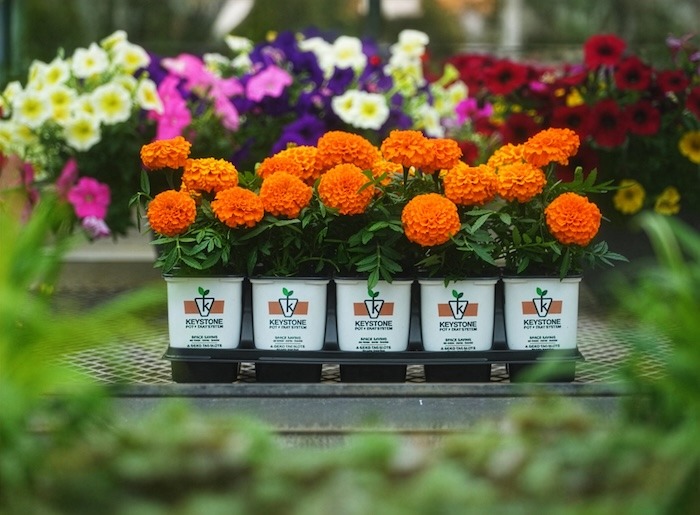
That same approach influenced our Keystone Pot & Tray System. Its stackable and automation-ready design increases truckload capacity by up to 25% while incorporating high levels of PCR material, helping reduce freight costs, emissions, and product breakage.
Q: What do you see as the future of sustainability?
The horticultural industry is moving toward connected systems where recycling, materials innovation, compliance, and logistics are all intrinsically linked.
The growers best positioned will be those implementing practical, scalable solutions that deliver measurable long-term value. Progress isn’t defined by one large initiative, but by instilling a values-driven culture of consistently seeking and improving sustainable systems over time.
For more information, please visit www.growscape.com.