

Duets: Plant breeding for CEA production systems
Explore how Andrew Ogden is reimagining crop breeding for controlled environments. Learn about CEA-ready squash, melons, tomatoes and more.





Today’s guest is Andrew Ogden, assistant professor of plant breeding for controlled environment agriculture at the University of Georgia (UGA). Andrew completed his doctoral degree at the University of New Hampshire (UNH) and recently returned to UGA, where he earned his master’s degree. He joined the UGA Department of Horticulture in 2023 and is also a member of the Institute for Plant Breeding, Genetics and Genomics.
Peter: Thanks for joining me today Andrew. Frame your CEA breeding program for us, as this category is relatively new.
Andrew: I am happy to be part of a team dedicated to CEA. Our team includes an entomologist, a plant pathologist, a crop physiologist and a crop phenomics/ agriculture engineer. My primary appointment is with the Department of Horticulture, with a 75% research and 25% Extension designation. Although I don’t have a teaching appointment, I am still able to mentor graduate and undergraduate students, teach growers and provide guest lectures.
While at UNH, I had the great fortune of conducting my doctorate under the direction of the late, great plant breeder Brent Loy. I think of him daily, and the wisdom he graciously shared with me guides my breeding efforts.
Peter: Loy was my undergraduate advisor a minute ago in 1972. His career as a plant breeder is full of commercial and home garden vegetable cultivar releases.
His focus was field production, yours is CEA. How does your program compare to a traditional program?
Andrew: My goal is to develop cultivars of specialty crops suitable for production in controlled environments like greenhouses, high tunnels and indoor vertical farms.
Today, in most cases, growers rely on cultivars that were developed for field production rather than production in CEA. Field production requires resistance to a distinct set of plant pathogens and environmental conditions than those found in CEA systems.
In my view, CEA occurs along a spectrum with low to moderate control offered by low and high tunnels, more control gained by low-, medium- and high-tech greenhouses, and the most control being offered by indoor vertical farms. Each increase in control creates an increase in startup and operational costs. Increasing costs create greater pressure for profitable crop production.
Not many crops beyond leafy greens have proven themselves to be profitable in the most sophisticated systems such as indoor vertical farms. For many years, profitable production inside of greenhouses was limited to ornamental plants. Now, thanks to improvements in greenhouse technology and production methods, we are seeing large-scale greenhouse production of a few key crops, namely tomatoes, lettuce and cucumbers. With major private sector investment taking place in breeding these main commodities, I am choosing to focus on more niche crops.
Peter: Your CEA continuum point reinforces that agricultural production systems are varied; simplicity is not an accurate descriptor. CEA lacking uniformity across its range of technology is an excellent point. I often cite that one size rarely fits all regarding agriculture’s many production categories. This must present challenges in terms of whether your breeding focus is high tunnel or high tech. How do you navigate this complexity in your breeding?
Andrew: I have initiated my breeding program following up on work I started on summer squash breeding while at the UNH. I have some breeding lines and hybrids in development in summer squash that feature specific attributes for greenhouse and high tunnel production. They have a nice vertical growing habit, can be trained to climb trellises and are glabrous (lack spines), so fruits do not get scratched by the stinging trichomes found on most squash plants.
Peter: The mention of the stinging trichomes on squash triggers childhood memories with stinging nettle while working in our fields, Andrew…thanks for that! We used stems as swords during work breaks — it was brutal.
A trellising summer squash sounds awesome. In CEA presentations I have a slide of rainbow-colored Swiss chard showing how breeding color into a green, leafy crop blurred the line between edible and ornamental crops. Traditional home gardens had flowers in the front yard and veggies in the back. We now have edible crops that are every bit as pleasing to the eye as flowers and deserving of front yard status. After asking audiences what the limiting factor is in crop breeding, my suggestion is … our imagination! As today’s resident Imagineer of trellised summer squash, what else are you working on?
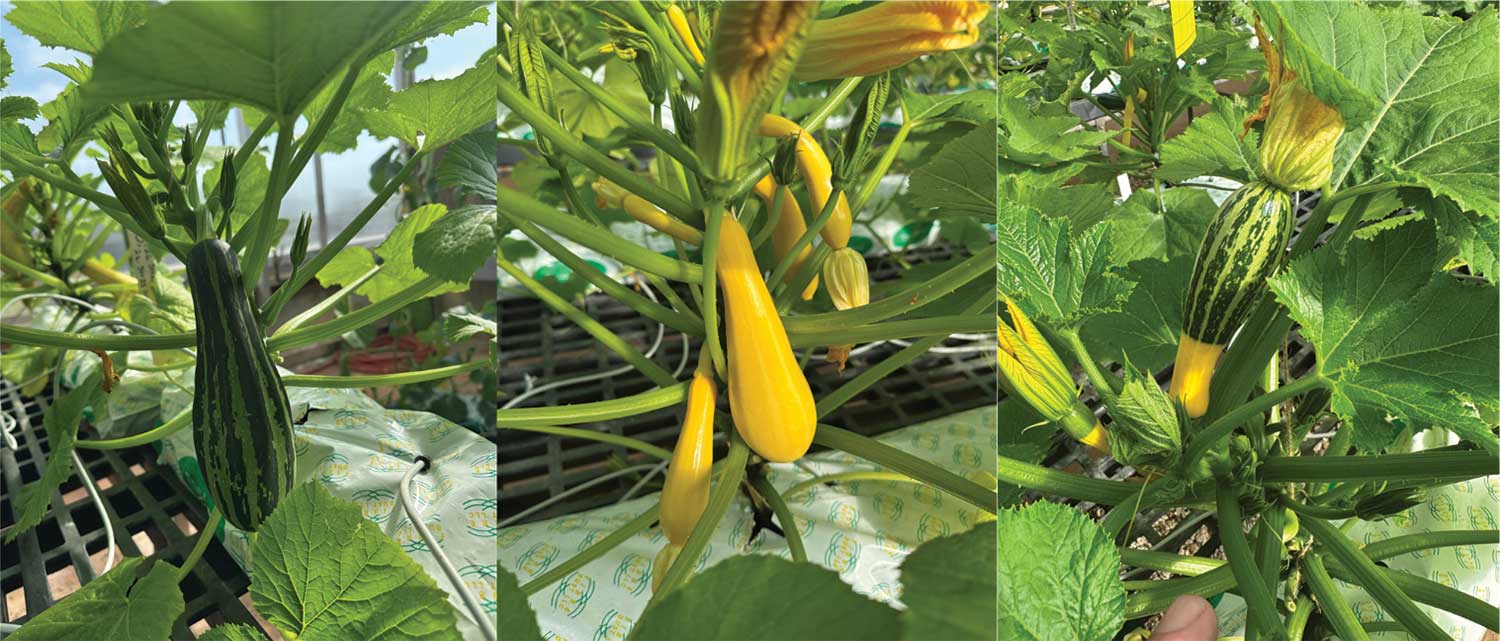
Striped summer squash thriving in greenhouse conditions. New hybrids available in
green, yellow and bicolor. Photo courtesy of Andrew Ogden.
Andrew: Next, I have incorporated genes for striping, which makes them very attractive. I also have them in a variety of colors including green, yellow and bicolor. I want my summer squash hybrids to all have resistance to powdery mildew (PM), which is a common and persistent problem in greenhouse cucurbit production. One major thrust of my breeding program is breeding for heightened resistance to powdery mildew.
While at UNH, a part of my dissertation described the discovery of a new source of resistance to PM. Efforts are ongoing to fully understand this new source of resistance and incorporate it into commercial varieties of squash and pumpkin. Interspecific gene transfer is possible among some of the species of squash and pumpkin but is not easy. Stacking resistance genes may be required to achieve good control of PM, but this is only feasible with the use of tightly linked molecular markers,which we are still developing for this new source of resistance.
I have also initiated a breeding program in melon, namely cantaloupe and specialty melons. Consumers of melon are often dissatisfied, as fruit quality varies so greatly depending on the season, cultivar and growing practices. Since we can optimize environmental conditions in CEA, there is an opportunity to breed and develop the needed cultural practices to produce melons of remarkably high eating quality that consumers are willing to pay a little bit more for. Globally, there is a great deal of diversity in melons beyond what we typically see in U.S. markets. I am incorporating a wide range of germplasm into my breeding program with hopes of breeding something unique to CEA systems. A key component for CEA producers and retailers is variety differentiation in the marketplace.
Thus, I hope to breed melons that are not only delicious but also with striking outward appearances that can be easily highlighted in the marketplace. One nice feature of being located at UGA’s Griffin campus is that we share the campus with the USDA, and we are one of seed storage locations for the USDA’s vast germplasm collection that is available for use by plant breeders. This, along with heirloom varieties and non-patented commercial hybrids, represents some of the sources of germplasm for my work.
Finally, I have initiated a brand-new program in tomato breeding. Here, I have a few different goals. I am attempting to develop some ultra dwarf/mini tomatoes with improved eating quality and a wider range of colors. These ultra-compact plants have potential for indoor vertical farms, home growers and even in space! There are only a handful of varieties currently available and are limited to mostly small red cherry tomatoes. I hope to breed some hybrid tomatoes that have some of the features of heirloom tomatoes — like great flavor and eye-catching looks — while incorporating features of hybrid greenhouse tomatoes like disease resistance. With the assistance of my post-doctoral researcher and collaborators in entomology, we are conducting research on tomato yellow leaf curl virus.
Peter: What are a few specialized criteria for specific crops that fly below regular radar that you’re working on?
Andrew: Along with a team of fellow plant breeders, we recently published a review paper that examines numerous crops with potential for CEA. This in-depth review paper covers both CEA crops and the methods and tools available to plant breeders today. It is available as an open access publication in Frontiers in Plant Sciences (Frontiers | Improvement of crop production in controlled environment agriculture through breeding). Important CEA traits include features like parthenocarpy, or fruit set and development without pollination and fertilization of ovules. Pollination is difficult in CEA systems and is a limiting factor for fruit crop production in CEA.
With the increasing use of robotic harvesters in CEA systems, breeders also seek to develop vegetable crops with greater amenability to automated harvesting. Tolerance to low-light conditions is a trait needed in vertical farms where light intensity levels may be less than optimal. Also, we cannot overlook disease resistance breeding, as some diseases like powdery mildew, bacterial spots and plant viruses can still pose problems in CEA systems.
High energy usage is also still a limiting factor in CEA production systems. So, breeding warm-season crops like cucumbers to tolerate cooler temperatures could help ease production costs for growers. Heat tolerance is also needed for greenhouse production located in warm regions of the earth where managing elevated temperatures in the greenhouse can be particularly challenging.
There is a lot of room for creativity and imagination in the world of plant breeding for controlled environment agriculture. Boosting crop nutritional content, breeding for elevated levels of antioxidant molecules and producing crops in areas where they could normally be not grown all represent exciting ideas for CEA breeding.
Peter Konjoian is president of Konjoian’s Horticulture Education Services and creator of Small Greenhouse and Farm Technology (SGAFT). His career spans four decades as a commercial grower, researcher and consultant. He can be reached at peterkfes@comcast.net. Andrew Ogden is assistant professor of plant breeding for controlled environment agriculture at the University of Georgia.