

Benefits of updating greenhouse climate controls go beyond providing plants with proper temperature and humidity
Learn when to replace greenhouse environmental controls and how upgrades improve irrigation, climate management and efficiency.





Key takeaways
- Older greenhouse controls may lack precision and replacement parts.
- Integrated irrigation and climate controls improve efficiency.
- Modern controls can reduce water use and labor costs.
- Environmental controls can improve crop production and ROI.
- Remote monitoring allows growers to manage facilities from anywhere.
When it comes to providing crops with the proper environment, greenhouse growers know the importance of maintaining, repairing and replacing the equipment used to heat and cool production facilities. But what about the environmental controls they use to operate this equipment? When to replace these controls may not be as clear cut.
AGING EQUIPMENT
Thermostats are still being used to control heating and cooling equipment.
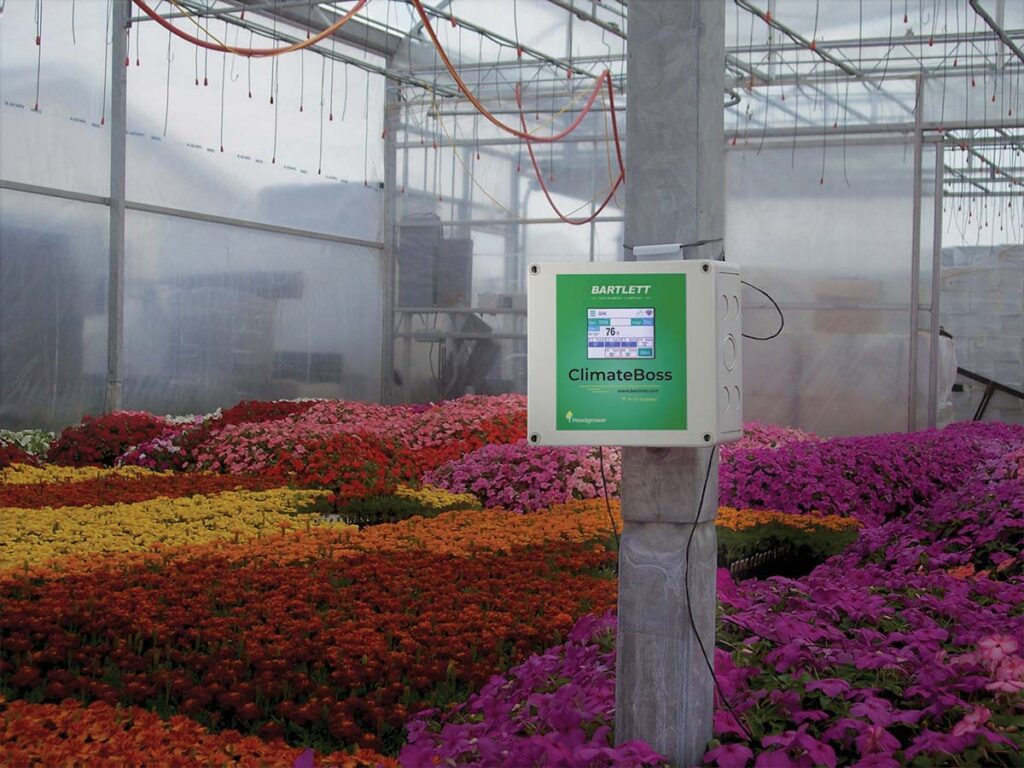
“When our company got into the greenhouse market in 1999, it was to replace thermostats,” said Molly Dishman, head of products at Bartlett Instrument Co. “If growers are still using thermostats, they are missing out on significant energy savings opportunities.
“Energy studies which we have done show that replacing thermostats not only saves growers energy but also saves them time. It’s usually a case of growers not thinking they will get the return out of the environmental controls as quickly as they expect. There can also be some sticker shock on environmental controls, so they decide to purchase a less expensive thermostat. What they aren’t calculating into the cost of using thermostats is the energy use or manual labor.”
Dishman said growers are using thermostats less often and they’re typically not installed in main production greenhouses.
“Thermostats are still being used in out-buildings or greenhouses with less control but still use some heat,” she said. “These could be simple cold frames or structures in which crops are held prior to shipping that don’t need a lot of environmental control.”
Patricia Dean, CEO at Wadsworth Control Systems, said some of the older controls still being used contain mercury switches that operate the greenhouse vents.
“Some of these older controllers can be set to 70° F, but not 70.5° F or in Celsius,” Dean said. “Also, the way the system is switched from day to night is by a photocell or clock time.
Dean said one of the reasons growers are still using older controllers is because they still work.
“These older controls were made in the 1970s and were built like tanks,” she said. “No one makes the parts for these controllers anymore. We try to explain to growers that eventually the temperature sensor is going to stop working and they’re not going to be able to order a replacement part or new controller and receive it overnight. We try to talk with the growers before their controllers stop working so that there is some coordination on how to replace them.”
Dishman said another sign an environmental controller needs to be replaced is the number of manual adjustments growers are making to their equipment and structures.
“Growers who have installed environmental controls to operate sidewall and roof vents, in many cases, have gotten their return on investment in a single season simply by not having to make manual adjustments,” Dishman said. “If any of the main equipment like vent motors, heaters, fans, any equipment used to control the temperature — if those are manually adjusted growers should be looking at the savings that are possible by updating their controls.”
COORDINATED CONTROL
Integrating irrigation with climate data helps growers better understand how watering affects humidity, temperature and overall plant performance while also reducing labor.
“When plants are watered, it impacts the greenhouse environment,” Dean said. “Irrigation can cause the temperature to drop and humidity to rise. If irrigation isn’t integrated with an environmental controller, growers can’t see all of those data points together. Older control systems often don’t collect this data at all, so growers are making irrigation decisions without seeing the full picture.”
Many growers are also upgrading their environmental controls to add irrigation control because watering plants can be a significant labor expense. Automating irrigation with smart sensors improves crop quality by addressing overwatering and underwatering.
“Research at the University of Florida has shown that many growers apply significantly more water than plants actually need,” Dean said. “The research shows that 30% to 80% of growers overwater, often because it is done by hand or scheduled by time instead of by plant demand. When irrigation is managed using substrate moisture sensors or climate data, water use can drop dramatically, often 30% to 90%, and improve plant growth.
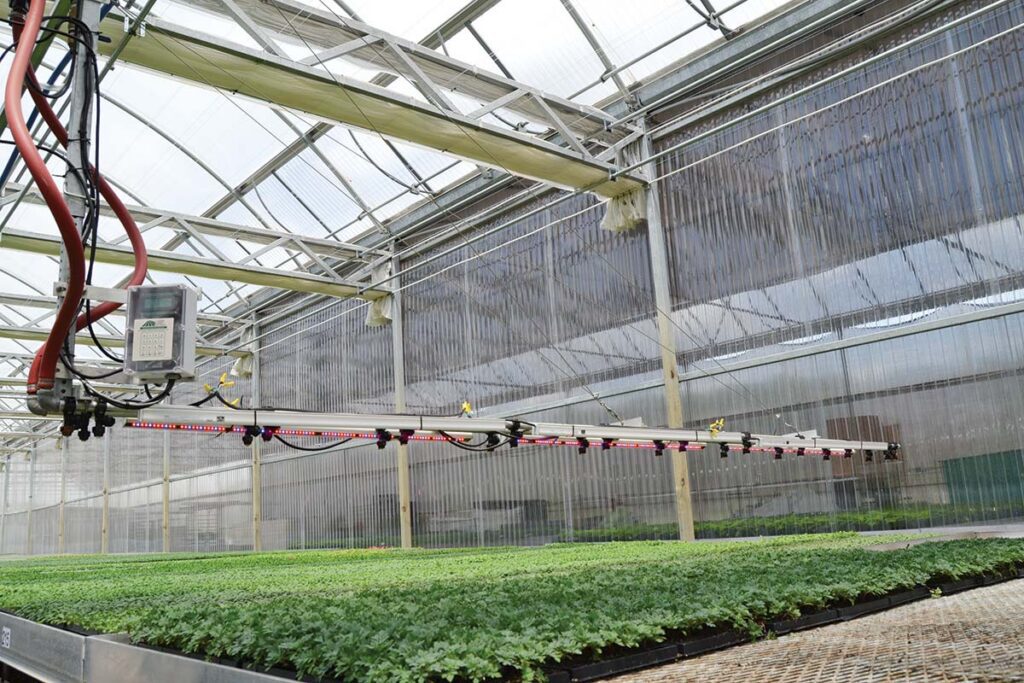
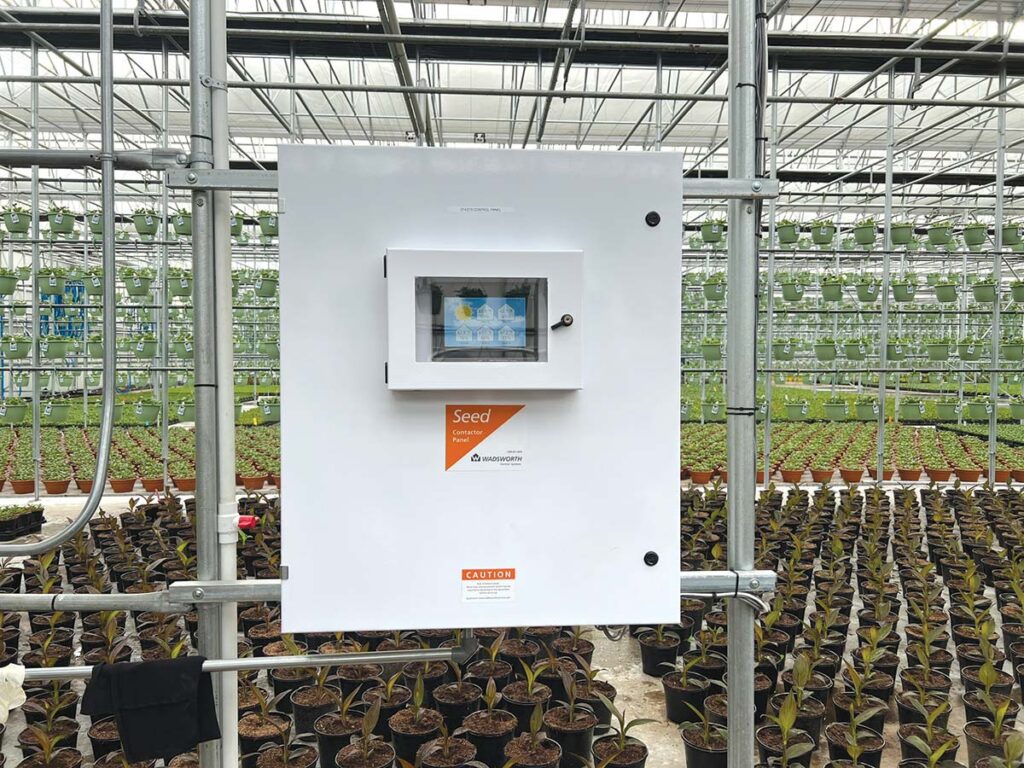
“Being able to better control input costs, including labor, water and fertilizer, is a major benefit of updating environmental controls. Greenhouse sensors have improved significantly, including soil moisture sensors. There are soil analyzers available that can measure moisture content, soil temperature and electrical conductivity.”
Dishman said it can be difficult for growers to lower the humidity in a greenhouse if they don’t have a humidity sensor integrated into their control systems.
“If growers can’t integrate a humidity sensor or they don’t have equipment that runs automatically based on a humidity setpoint, that is a sign that they should upgrade,” she said. “This would be a controller that operates both the heating and cooling equipment to dehumidify the greenhouse. In the case of dehumidification, this is done primarily to help control diseases. However, growers may also want to humidify the greenhouse, especially if they are producing foliage plants.”
INCREASE IN PRODUCTION
Brent DeArmond, West Coast sales representative at Wadsworth, said growers can use the control system to increase production, through both better irrigation and better management of the climate.
“I’m seeing a lot of change lately with a newer generation of growers who see the benefits of advanced environmental controls,” he said. “Greenhouse control systems are advanced enough that they can dial in all the environmental settings and irrigation rates to actually increase production. Environmental controls not only maintain the greenhouse environment at a desired setpoint but also can be used as a tool to improve the business. With the development of AI and better systems for analyzing large data sets, growers can archive all of the data from their systems and make better future decisions to increase productivity.
“There are growers who are operating their greenhouses with old controls. In many cases, if we ran a ROI analysis, even if they just got a 2% increase in production based on maintaining a better climate and irrigating better, a new controller might pay for itself in six months.”
Dishman said growers who are using supplemental lighting can optimize plant growth based on daily light integral (DLI) or light set points using environmental controls.
“If there is no way to integrate the light the plants are receiving naturally into the environmental control system, that is a sign a grower could use more control,” she said. “This would be for both natural light and supplemental light. It’s also an energy savings opportunity.”
Dean said many older controls don’t have the ability to track DLI.
“The older controls only turn the grow lights on between certain time intervals,” she said. “With newer controls, growers can measure whether or not the DLI has been reached. If the plants have received enough light for the day, the grow lights don’t need to be turned on again.”
REMOTE ACCESS AND MOBILE MONITORING
Dean said growers increasingly expect to be able to monitor their greenhouses remotely, receive alarms for issues like power loss or temperature issues and make adjustments from their phones or computers.
Dishman said if growers are worried about their greenhouses and their crops and data can’t be seen on their phones or in some other remote way, it’s probably time to upgrade their environmental controls.
“A grower should know that the environmental controls are going to close the vents, turn on the heat or turn on the exhaust fans,” she said.
FAQs
What are signs greenhouse environmental controls should be replaced?
Frequent manual adjustments, outdated thermostats and lack of remote monitoring can indicate the need for replacement.
Why are growers upgrading environmental controls?
Growers are upgrading to improve irrigation management, reduce labor and increase production efficiency.
How do modern controls help irrigation?
Growers are upgrading to improve irrigation management, reduce labor and increase production efficiency.
Can environmental controls improve greenhouse production?
Yes. Advanced controls can optimize temperature, humidity, lighting and irrigation to improve production.
What is DLI in greenhouse production?
DLI stands for daily light integral and measures the amount of light plants receive each day.
David Kuack is a freelance technical writer in Fort Worth, Texas. He can be reached at dkuack@gmail.com.