

When it comes to controlling ornamental plant growth, growers have options
Growers have options when trying to control ornamental plant growth. These include the cultural practices of watering, fertilization and environmental control, as well as the application of plant growth regulators (PGRs).





“In Europe where there are a lot of monoculture crops produced, it is easier to manipulate the environment specifically to the crop,” said Joe Moore, head grower at Lucas Greenhouses in Monroeville, New Jersey. “North American growers tend to grow multiple crops. A lot of times, especially with smaller growers, a greenhouse could have 20 different crops in it that all have a different optimum temperature, requiring the grower to find a happy medium.

Joe Moore, head grower at Lucas Greenhouses, said PGRs are a vital part of its production methods. Photos courtesy of Lucas Greenhouses.
“This is where PGRs come into play. A certain crop may have to be grown warmer than it should be, but because there are other crops in the greenhouse, a warmer temperature is needed.”
With concrete heated floors in every bay at Lucas Greenhouses, Moore has the ability to set a different temperature on the floor.
“I can control the temperature in all the bays separately as opposed to the entire greenhouse slab having to run at one temperature,” he said. “This gives us the ability to speed up or slow down a crop simply by adjusting the environment in one bay.”
Even with the ability to control plant growth with cultural practices, PGRs are a vital part of the production methods used at Lucas.
“We use a PGR of some form on almost every crop that we produce,” Moore said. “Almost everything we grow requires some type of PGR. Our primary focus is annuals for spring, which includes vegetative and seed-grown crops. We grow summer and fall crops, which includes traditional mums and pansies, and then we also produce poinsettias. Nearly every one of those crops receives a PGR treatment with different rates and different chemicals.”
Annual crops receive a PGR treatment depending on the sensitivity to the chemical applied.
“Begonias are very sensitive to PGRs,” Moore said. “An 804 flat of Prelude or Harmony begonias only needs a light ancymidol spray application, and then the growth is controlled using the environment. For more vigorous begonia varieties like a Dragon Wing type, plants might need to be treated with an ancymidol/ daminozide tank mix.”
CONTROLLING THROUGH CULTURAL PRACTICES
Moore said the company’s climate controlled open roof greenhouses enable its growers to achieve a lower humidity, better air flow and cooler temperatures. There are also unheated Quonset-style greenhouses with roll-up sides along with outdoor field production.“We also use fertility and water management to control plant growth,” Moore said. “The more fertilizer applied to a crop, the lusher the growth and the faster the plants grow. If these inputs are restricted, plants can also be toned that way.”
For most crops, Lucas Greenhouses runs heat through the floor for improved plant structure development. Maintaining a warm temperature in the growing substrate allows for the air temperature to be cooler.
“If plants are grown with both cooler air and root temperatures, sometimes there can be issues with higher disease outbreaks,” Moore warned. “As much as possible, we try to have the same crop in a bay, or crops with similar requirements whether that be moisture, temperature or humidity. If we are growing angelonia in a bay, we would pair it with another crop that prefers warm roots like hypoestes or sanvitalia.”
MINIMIZING APPLICATIONS
At Young’s Plant Farm in Auburn, Alabama, over 90% of the plants produced receive a PGR treatment.PGR applications could be to encourage branching, abort flowers or to tone the plants at finishing — this reduces transpiration for plants that are going to be placed in a harsh retail environment. “
Just about every plant we produce receives a PGR application once to several times during the production period,” said Tom Costamagna, director of horticulture at Young’s. “Some of that is related to the container size.”

Tom Costamagna, director of horticulture at Young’s Plant Farm, said some crops require PGRs for best quality and postharvest longevity. Photos courtesy of Young’s Plant Farm.
“The name of the game is how many dollars can be put on a shipping cart and how many dollars can be put on a semitruck. Even though we grow a lot of large combinations, there is still a lot of genetics produced in small pots that are not conducive to being grown in small packs and pots. The only way we are able to produce some of these crops as quality plants, and to have good postharvest longevity for our customers, is with PGRs.”
Costamagna shared that Young’s Plant Farm produces over 200 species of plants — the total number of cultivars being several thousand. He said the list of plants is ever-changing, whether that is the result of better genetics, branded programs or other reasons.
“We drench the PGRs because we grow so many species and cultivars in the greenhouses,” he said. “Crops are laid out in compartments based on their average daily temperature and light requirements. We don’t spray because inevitably overspraying can occur or something that shouldn’t be sprayed is treated. We treat the plants with a drench because it is consistent. Some of that will be done with packs grown on tables. Some of that may be done with a boom system.”
Young’s designed and built a manual boom, which operates similarly to a mechanical or automated boom. Instead of running on a track that rides on heating pipes or rails above tables, the manual boom is equipped with casters which allows it to be moved on the ground.
It previously took eight workers to apply PGRs in one day, but using the manual boom only requires two workers to apply the same amount of chemical to the same area.
“The manual boom is equipped with a hose that is attached to a Dosatron injector. Most crops are finished on the floor because that provides us with the most spacing options. The boom is our primary method of delivery for chemical drench applications whether it is a PGR, fungicide or insecticide.
“Our goal is to be the most efficient. We want to make one application. The applications are made based on the time of year, the size of the containers and the vigor of the plants. There is a balance of how much is applied, what is applied based on the container size and the plant species or variety. Every time we make a second application it costs more in terms of manpower, chemicals and time,” Costamagna said.

A manual boom is equipped with casters to apply PGR drenches. Photos courtesy of Young’s Plant Farm.
VARIETIES REQUIRING LESS
With the rising costs of labor and goods globally, ornamental plant breeders are working to develop cultivars that require fewer inputs.Labor is every production greenhouse’s biggest expense, said Alicain Carlson, head of marketing, Americas for Syngenta Flowers. A less intensive way of reducing that cost is to select genetics that require fewer steps in production, like no pinching or fewer to no PGR applications.
“Globally, there are also challenges with chemical growth regulation from regulatory restrictions to lack of access to products in certain countries,” Carlson said. “As plant breeders, we have many reasons to focus on varieties with genetically more controlled growth habits. For many of our key crop categories, there is an objective to breed for more controlled growth habits, to reduce PGR requirements to cut labor and input costs and make growing easier for our customers.
“There are many varieties available and growers should look for phrases like ‘genetically compact,’ ‘controlled habit,’ ‘dwarf’ or ‘reduced vigor’ in the variety descriptions. Growers should trial these varieties to see if they produce the desired product in their unique growing conditions.”

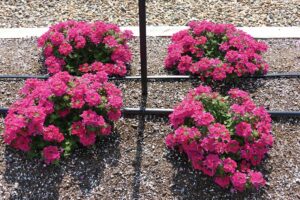
Being a Southern grower, Young’s Plant Farm generally grows compact varieties because under high light and warm temperatures these selections tend to grow similarly to medium vigor genetics.
Costamagna mentioned that verbena ‘Vanessa Compact’ provides a good example of a series that would be considered a no or low dose PGR option for Northern growers but still requires a PGR application at finish. “Other genetics that fall under these criteria include: euphorbia ‘Glitz’, Conga calibrachoa series, Gem lantana series and Cora XDR vinca series,” he said.
Everything produced at Young’s is trialed by the team — the trial garden has been operating for 13 years now. Penny Merritt-Price, product development manager for Young’s, monitors performance and recommends substitutions for varieties that are not hitting the mark, including heat tolerance.
“Our trial garden gives us the ability to adjust our production varieties to include those that perform best in the mid-south. This will help ensure the highest success potential for consumers who purchase our product from regional garden centers,” Costamagna said.

Penny Merritt-Price, product development manager at Young’s Plant Farm, makes selection recommendations based on the company’s greenhouse trials and trial garden. Photos courtesy of Young’s Plant Farm.
PERFORMANCE IS CRITICAL
At Lucas Greenhouses, Moore said he is in a wait-and-see mode when it comes to producing no or low dose PGR varieties.“If breeders can develop varieties that are more compact naturally in the spring and require less PGRs, but yet have good summer performance that consumers expect and demand, then we certainly would begin to migrate that way,” Moore said.
Lucas had over 2,000 containers in its summer trials this year.
Moore evaluates all of the products that Lucas offers as a liner producer, and he handpicks from the trial each year to keep a strong mix for its garden center and landscape customers. Considerations for choosing from the trial garden include varieties that can realistically be produced under greenhouse control, gives the “bang for your buck” factor for landscapes and has great summer performance.
“Some of the more naturally compact varieties may not have the summer performance that is needed, especially with high night temperatures, high humidity and thunderstorms. Varieties that can be controlled more easily in the greenhouse, that still have the punch in the landscape, we would absolutely be interested in,” Moore said.
David Kuack is a freelance technical writer in Fort Worth, Texas. He can be reached at dkuack@gmail.com.