

Technically Speaking: Nitrogen forms and why they matter in soilless substrates
Learn how nitrate, ammonium and urea influence substrate pH, nutrient availability and crop health in greenhouse production. See what this means for growers.





Key takeaways
- Nitrogen is supplied as nitrate, ammonium or urea.
- Nitrate is immediately available and highly leachable.
- Ammonium can reduce substrate pH and accumulate under some conditions.
- Urea requires microbial conversion before becoming plant available.
- Water alkalinity influences fertilizer selection.
- Excess ammoniacal nitrogen can cause crop toxicity during low-light, cool conditions.
The selection and application rate of fertilizer varies widely among commercial greenhouse growers. In fact, fertility is one of the most variable cultural inputs in the industry. Ideally, a fertilizer (or sometimes multiple fertilizers) should be based on several factors, including water quality, crops grown, growth stage, environmental conditions and cost.
Why is fertilizer selection and rate important?
First, an inappropriate fertilizer can be more expensive than necessary; specific nutrients are sometimes applied excessively and application rates can be more than the crop can use. This can lead to excessive nutrient leaching from containers and loss to the environment.
An unsuitable fertilizer can also cause nutrient deficiencies or toxicities. This article focuses on the different forms of nitrogen in water-soluble fertilizer, which can influence the substrate pH and cause ammonium toxicity.
There are three different forms of nitrogen (N): nitrate, ammonium and urea. All three forms of nitrogen are delivered with hydrogen (H), oxygen (O) and/or carbon (C). Each of these three forms is briefly described below in relation to growing floriculture crops in soilless substrates.
Nitrate is NO₃⁻
Nitrate easily dissolves in water and is immediately available to plant roots. Thus, nitrate is commonly the backbone of a fertilizer, constituting at least 60% of the nitrogen applied to crops for many common fertilizers (Table 1).
Because of its negative charge, nitrate does not attach to organic substrate components such as peat, wood fiber or bark, or coconut fiber (coir). This causes excess fertilizer to leach through containers. In addition, its uptake by plants can slowly increase the substrate pH from charge balance mechanisms.
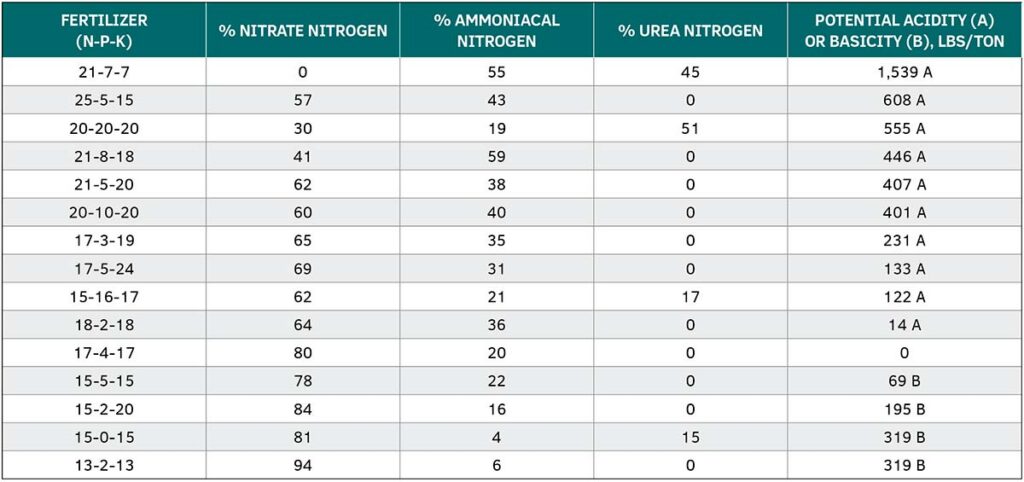
applied to floriculture crops in soilless substrates. Fertilizers with a moderate to high percentage of ammoniacal and urea nitrogen can
decrease the pH of a substrate over time.
Ammonium is NH₄⁺
In some ways, this form of nitrogen acts opposite that of nitrate. While it is rapidly available to plant roots, its positive charge enables it to readily bind to peat, wood fiber, coir and other organic materials commonly used in growing substrates.
These materials can partly immobilize ammonium, making it less available to plant roots, but that also means it has less potential to leach. Over time, ammonium can accumulate in the root zone as well as inside plants and become toxic during slow-growing conditions.
Urea is CH₄N₂O
Unlike the other two forms of nitrogen, urea is not immediately available for root uptake. Instead, it needs to be converted by microbes to ammonia (NH3), then to ammonium, and finally to nitrate. This process is relatively slow in fresh, soilless substrates because they lack microbial activity.
Its conversion process depends on the substrate temperature, moisture content and pH, as well as other factors. It proceeds rapidly when the root zone is warm and moist, and soil pH is near neutral; and slows down at lower temperatures, in dry or wet substrates, and when the pH is acidic.
When the conversion to ammonia is slow, it is subject to leaching. For these reasons, urea is less common in fertilizers used to produce crops in soilless substrates.
Using ammonium to regulate substrate pH
Over time, the positive charge of ammonium can decrease the substrate pH. Fertilizers with a high percentage of ammonium (or ammoniacal nitrogen) usually have greater potential acidity (Table 1). The potential acidity or basicity refers to the long-term effect on decreasing or increasing the substrate pH, respectively.
Generally, the percentage of ammonium in fertilizer should be based on the alkalinity of water. Water with a high alkalinity (150 to 200 ppm or higher) increases a substrate’s pH, and using a fertilizer with ammonium can counter that pH rise.
If the water alkalinity is even higher, growers may have better results injecting an acid (such as sulfuric acid) to control the substrate pH rather than only relying on a fertilizer with a high percentage of ammoniacal nitrogen.
Beware of ammoniacal nitrogen toxicity
Ammoniacal nitrogen refers to both ammonium and ammonia (or urea). While root uptake of ammonium (but not ammonia) is rapid, excessive amounts can cause toxicity. The potential for ammonium toxicity is low when plants are actively growing.
However, when growing temperatures and light levels are low, growth is slow and ammonium toxicity becomes more likely. This is why during the winter and early spring, growers in temperate climates like the northern U.S. are more likely to encounter toxicity when using a fertilizer with a moderately high percentage, such as at least 30%, of ammonium and urea.
A large number of floriculture crops are reportedly sensitive to ammoniacal nitrogen toxicity, including coleus, pansy, pepper, petunia, ranunculus, salvia, snapdragon, tomato, verbena, vinca and zinnia. The symptoms can vary by crop and include marginal or intervenal chlorosis, upward or downward leaf curling, abortion of growing tips, leaf tip burn and poor root growth.
If you suspect ammonium toxicity, send a substrate sample to a professional lab for analysis. If the ammonium is high (at least 10 to 15 ppm), light is low and temperatures are cool, consider leaching the substrate with a highly nitrate-based (dark weather) fertilizer.
Additional corrective actions include increasing the temperature, maximizing light to the crop, decreasing the fertility concentration and raising the substrate pH if it is too acidic.
FAQ
What are the three forms of nitrogen in fertilizer?
Nitrate, ammonium and urea.
Why is nitrate commonly used in fertilizers?
It dissolves readily in water and is immediately available to plant roots.
How does ammonium affect substrate pH?
Over time, ammonium can decrease substrate pH.
Why is urea less common in soilless substrates?
It requires microbial conversion before plants can use it.
When is ammonium toxicity most likely to occur?
During periods of low light, cool temperatures and slow plant growth.
Erik Runkle is professor and floriculture extension specialist in the department of horticulture at Michigan State University. He can be reached at runkleer@msu.edu.