

Photoperiodic vs. Photosynthetic Lighting





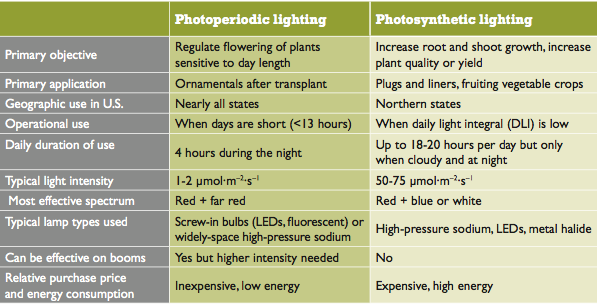

Table 1. Comparisons between delivering photoperiodic and photosynthetic lighting to a broad range of greenhouse-grown crops.
In contrast, lamps that emit red and far-red light are usually the most effective at promoting flowering of a wide range of long-day plants, especially when the daily light integral (DLI) is low.
The primary application of photoperiodic lighting is after transplant and when the natural day length is short. For spring-finishing crops, that usually means lamps are operated from January to early April. Once the natural photoperiod is long, there is no value of photoperiodic lighting and so lamps should be turned off.
High-intensity (supplemental) lighting increases growth. Photosynthetic lighting delivers a much higher intensity, typically around 50-75 _molám-2ás-1, but even higher intensities are used on high-wire vegetable crops. This type of lighting increases photosynthesis and during periods of low light, it can accelerate rooting and increase stem diameter, branching and flower number of ornamentals.
When lighting is only used part of the year (three or four months), high-pressure sodium (HPS) lamps with electronic ballasts are often the most economical light source when growing ornamentals. However, the best LEDs are now more efficient than the best HPS lamps while the cost of LEDs continues to come down, making LEDs increasingly cost competitive.
Photosynthetic lighting can also be used to create long days, either by operating all lamps or a small subset (e.g., 10 percent) of them. There’s no need to have both lighting systems in the same greenhouse space.