

The efficacy of potassium silicate in alleviating boron toxicity in Lilium longiflorum
See how potassium silicate reduced boron toxicity and restored lily growth in a greenhouse trial. Read through the results and apply the method.





There are many known abiotic causes of stress in plant production such as metal toxicity, drought and soil pH/EC (Zhang et al.,2017). Boron is an essential micronutrient; however, excessive boron can cause toxicity in plants (Zhao et al., 2024). Boron is mostly taken up by the roots of the plant as Boric acid, and plays an important role in plant metabolism and cell wall and membrane function and structure (Brdar-Jokanović, 2020).
Boron toxicity is described as yellowing on the tips of bottom leaves which progresses towards the stem and upwards throughout the plant. If left untreated, yellowing tissue will become necrotic, and progress towards the stem and upwards throughout the plant. Plants displaying symptoms of Boron toxicity have 47% less dry weight than unaffected plants (Barnes et al., 2011).
Boron toxicity can be caused by a number of factors such as: over-fertilization, high levels of boron in potting soil or boron-rich water (Behtash et al., 2024). Bioavailability of boron is dependent on a number of soil properties, and can have significant undesirable outcomes: reduced shoot and root growth (stunting), leaf chlorosis (yellowing) and necrosis, and impaired photosynthesis (Zhao et al., 2024).
Silicon is known to elevate plant tolerance to various abiotic stresses such as drought, salinity, metal toxicity caused by excess nutrients and can improve disease resistance. Applications of silicon in field crops can improve biomass, yield, plant growth, cell wall production, chlorophyll production and enhances drought tolerance. There is evidence that silicon can alleviate boron toxicity and enhance boron tolerance in some field crop species (Behtash et al., 2024).

Sil-Matrix, a chemical produced by Certis Biologicals, is a liquid concentrate solution with 29% potassium silicate. Sil-Matrix is labeled for foliar spray, chemigation, drip and flood irrigation systems. Potassium silicate has a unique mode of action which allows it to be utilized as a fungicide, insecticide and miticide while also improving overall plant health.
Materials and methods
The purpose of this trial is to better understand mechanisms by which boron toxicity can be limited or otherwise eliminated with the use of potassium silicate. Trail took place over 3 weeks, followed by a 2 week latency period to ensure no phytotoxicity or other negative effects were inflicted upon the plants, as well as to ascertain if gains generated via the use of potassium silicate would diminish over time.

Plants were diagnosed with having abnormally high levels of boron by JR Peters Laboratory. Boron levels in lily bulbs were found to be 351.0 ppm, whereas the normal range for Boron is 30 ppm to 50 ppm. Healthy lily crops that were also tested at this time returned results of 28.58 ppm, which is slightly lower than normal range; however, this does not appear to cause any damage. Boron levels in the soil sample of the inflicted lily were 1.82 ppm, whereas normal range is 0.5 to 1 ppm. Boron levels in the healthy lily soil sample was 0.09, which is lower than the normal range, but does not seem to have any negative effects on the plants.
All plants except one control group also received Wicked Green, a biostimulant trial which was started at the beginning of the season and before the boron toxicity was diagnosed. Wicked Green is a biostimulant made from algae which enhances physiological processes of plants.
Each control group was comprised of 25 individuals, and each trial group was comprised of 100 individuals. All groups featured individuals of different plant size, pot size, and damage inflicted by Boron toxicity.
Trial performance
Trial preformed on 2/20/2025, week 8
Trial preformed on 2/27/2025, week 9
Trial preformed on 3/05/2025, week10
Two weeks without Sil-Matrix to ascertain if phytotoxicity or reversal of effects.
Treatment preformed on all Easter lilies 3/19/2025, week 12
Rate: 7 oz Sil-Matrix/100gal
Control 1: no Sil-Matrix no Wicked Green
Control 2: Wicked Green but no Sil-Matrix
Trial 1: drench with Sil-Matrix at 7oz/100 gal
Trial 2: spray with Sil-Matrix at 7oz/100
Results
Week 9
Plants which receive drench or spray applications show improvement after only one week, with drenched plants showing the most improvement. Yellow is diminishing in both trial groups, with drenched individuals showing the most improvement.
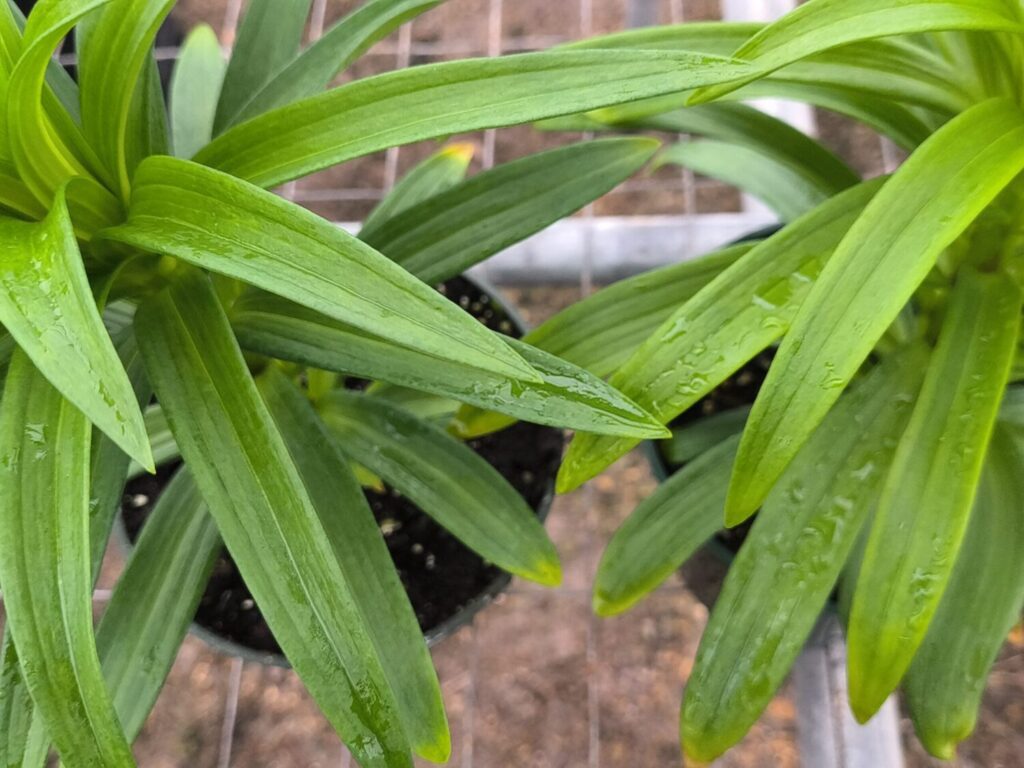
Fig 3. Trial plants are to the left side in both images, images taken wk 9. Trial plants begin showing healthier color after the first application, yellow on the leaves is receding towards the tips. Necrosis appears to be halted on trial plants, while it continues to spread on untreated plants.
Week 10
Yellowing of plants continues to diminish and necrosis does not seem to have progressed along the leaf towards the stem in drench application. Spraying does seem to reduce yellowing and slow necrosis.

Week 11
Plants which have received Sil-Matrix drench have little to no yellowing and significantly reduced necrosis at the leaf tips. Plants which received Sil-Matrix spray have reduced yellowing and necrosis; however, they only have slightly less yellowing and necrosis than the plants which received only Wicked Green biostimulant.
Plants that did not receive Sil-Matrix or Wicked Green have much more advanced necrosis, and several lost multiple leaves or plant was lost entirely. No phytotoxicity was noted at any time during trial.
Week 12
During the two week break to see if the treatments would persist without reapplication, some yellowing was noted throughout crops which had received spray treatments; however, the chlorosis was not present in a significant portion of crop. At this time Sil-Matrix was applied to all Easter lilies without negative effects noted. Trial was ended week 13.

Trial progressed fully without any noted phytotoxicity in the Easter lilies due to the use of the Potassium silicate. Drenching the Easter lilies at a rate of 7oz/100gal appeared to visibly reverse chlorosis in Easter lilies afflicted with Boron toxicity, and halt the spread of necrosis. Obviously necrotic tissues on plant leaves cannot be reversed; however, the damage appeared to be entirely halted after the first application without recurrence even after the applications were discontinued for two weeks.
Introducing the Potassium Silicate via spray seem to be much less effective than the drenching method; however, it did reduce the amount of progressive damage when compared to either of the control groups used in this trial. Spraying reduced the spread of necrotic tissue without halting it completely, but did reduce the chlorosis in the plants. Plants within this trial group also displayed continuing damage when the potassium silicate was withheld for two weeks.
Control group 2 trial which only received Wicked Green, but not the potassium silicate had more damage than the Sil-Matrix spray trial, but less damage than the control group with received neither product.
Control group 1, which received neither Sil-Matrix or Wicked Green had large amounts of damage which included: undesirable unhealthy yellow coloring, loss of multiple leaves, stunting, reduced number in flowering buds, no bud development at all or complete loss of plant due to death.
Discussion
This trial and its results are based on the growers perception, and were not independently measured using formal means for a more quantitative understanding of the halting or reversal of damage. As such, further testing is suggested to more fully understand appropriate rates and treatment options, as well as a more specialized understanding of physiological process involved.
Sil-Matrix is produced by Certis Biologicals, and trial was preformed independently by grower without instruction or recommendation. The trial was started as an effort to reduce the damage in an Easter lily crop which was active in production, and was based on research before mentioned.

The author, Stevie R. Goesmann, works for Alexander Hay Greenhouses in Apopka Florida, and certifies that they have no affiliations with or involvement in any organization or entity with any financial interest or non-financial interest in the subject matter or materials discussed in this manuscript.
After the initial trial was started, Certis Biologicals recommended AgSil25 which is a liquid nutrient solution also produced by the company which was not widely available in Florida at the start of the trial. AgSil25 is 21% silica and 8% potassium derived from potassium silicate, and is labeled for both foliar use and can be added to a fertilizer program. AgSil 16H may be a more convenient and affordable product, assuming rates are maintained, to mitigate Boron toxicity symptoms in Easter lilies; however, it was not available to trial at this time. Author would recommend a secondary trial of this product to ascertain efficacy and value.
Conclusion
While there will always be more to learn about mitigating abiotic damage in plant production, working together and sharing research across all types of agriculture benefits all agricultural workers. The results of this trial suggest that potassium silicate can be used to mitigate boron toxicity in field crops, and that knowledge can also be applied to seasonal flowering plants in greenhouse production. In the future, more research needs to be communicated across all areas of agriculture production throughout the world to induce a better understanding and a higher quality of best practices in plant production.
Bibliography
- J. Barnes, B. E. Whipker, I. McCall, Characterization of Nutrient Disorders of Lilium longiflorum ‘Nellie White’ and Lilium Hybrid ‘Brunello’ . USDA.gov (2011), (available at https://www.ars.usda.gov/ARSUserFiles/50820500/GPRG/2011PublicationsandSummaries/CharacterizationOfNutrientDisordersOfLiliumLongifoliumNellieWhite[Article].pdf).
- F. Behtash, F. Mogheri, A. Aghaee, H. S. Hajizadeh, O. Kaya, Role of silicon in alleviating boron toxicity and enhancing growth and physiological traits in hydroponically cultivated Zea mays var. Merit. BMC Plant Biology (2024), (available at https://bmcplantbiol.biomedcentral.com/articles/10.1186/s12870-024-05275-2).
- M. Brdar-Jokanović, Boron Toxicity and Deficiency in Agricultural Plants. PubMed (2020), (available at https://pubmed.ncbi.nlm.nih.gov/32093172/).
- Ma JF. Role of silicon in enhancing the resistance of plants to biotic and abiotic stresses. Soil Sci Plant Nutr. 2004;50(1):11–8.
- S. Zhao, E. Huq, shah Fahad, M. Kamran, M. Riaz, Boron toxicity in plants: understanding mechanisms and developing coping strategies; a review. PubMed (2024), (available at https://pubmed.ncbi.nlm.nih.gov/39316270/).
- Zhang W, Xie Z, Lang D, Cui J, Zhang X. Beneficial effects of silicon on abiotic stress tolerance in legumes. J Plant Nutr. 2017;40(15):2224–36.
Stevie R. Goesmann is head grower of flowering plants at Alexander Hay Greenhouses in Apopka, Florida.