

Purple vs. Pink vs. White LED Fixtures





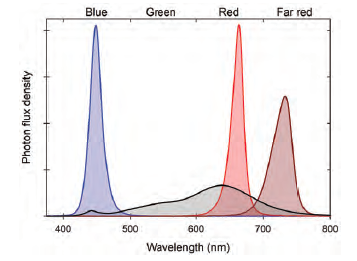
The second type of LED emits a broader range of colors that emits a white or whitish light, and is referred to as “broad band” radiation. White light is a blend of blue, green and red wavelengths; there are no white wavelengths.
Essentially, all white LEDs are really blue LEDs that are coated with a substance (phosphors) that converts some of the blue light into longer, less energetic wavelengths. Because most lighting applications are for people, not plants, by far the greatest demand for LEDs is for white. This has led to rapid technological advances in blue LEDs to create white LEDs. As a result, the efficacy of blue (white) LEDs is now quite high while their cost has become extremely cheap.
Second, red light has been considered the most effective at driving photosynthesis, which is true on an instantaneous basis, but we are learning that is not necessarily true over time. Third, many plants develop elongated growth under only red, and so blue is added to increase compactness and create a more typical, or sometimes shorter plant.
The major downside of red+blue LED fixtures is the potential effect on people, not plants. When there is no other source of light, such as inside a greenhouse at night, the purplish light can create an undesirable work environment. Plants don’t appear green and so detecting problems can be impeded.

Figure 1. The relative emission (at the same total photon flux density) of four common types of LEDs used in horticultural lighting applications. Blue, red and far-red LEDs emit a relatively narrow band of radiation, while warm-white LEDs (black line) emit a broad band of radiation.
Pink LED fixtures usually contain red and white LEDs, creating a less purplish, whiter light than purple LED fixtures. These fixtures are usually slightly less efficient than purple LED fixtures because white LEDs are slightly less efficient than blue LEDs. However, the spectrum is more pleasing to the eye. Obviously, the degree of whitish or purplish light depends on the percentages of white and red LEDs used in the fixture.
Another way to create white light with LEDs is to combine blue, green and red LEDs. However, this is usually not done because green LEDs are much less efficient than red and blue LEDs.
One final consideration is far red light, which we can barely see but promotes extension growth in most crops and flowering in some crops. With a red+blue LED fixture, there is no far red and so plants are sometimes shorter, especially during light-limiting conditions, than under fixtures that include some far red. White LEDs emit some far red, and so plants may be slightly taller, and some plants may flower slightly earlier, than under red+blue LEDs.
To summarize, there is generally a tradeoff between energy efficacy of an LED fixture and people’s preference of a light spectrum. LED fixtures that emit a purplish light are usually less preferred by people, but are often the most efficient at converting electricity into light useful to plants.
White LED fixtures create a more pleasant environment, and the spectrum is similarly useful to plants as purple light, but fixtures are usually less efficient. Red+white LED fixtures create a pinkish light that seems to be a good compromise between efficacy and lighting preferred by people.
Erik Runkle is professor and floriculture Extension specialist in the department of horticulture at Michigan State University. He can be reached at runkleer@msu.edu.