

Spring crop edition: Don’t take turns, make them!
Finish spring crops on time with smart scheduling, temperature and flowering strategies that reduce delays and labor. Learn the key tactics.


SCHEDULING
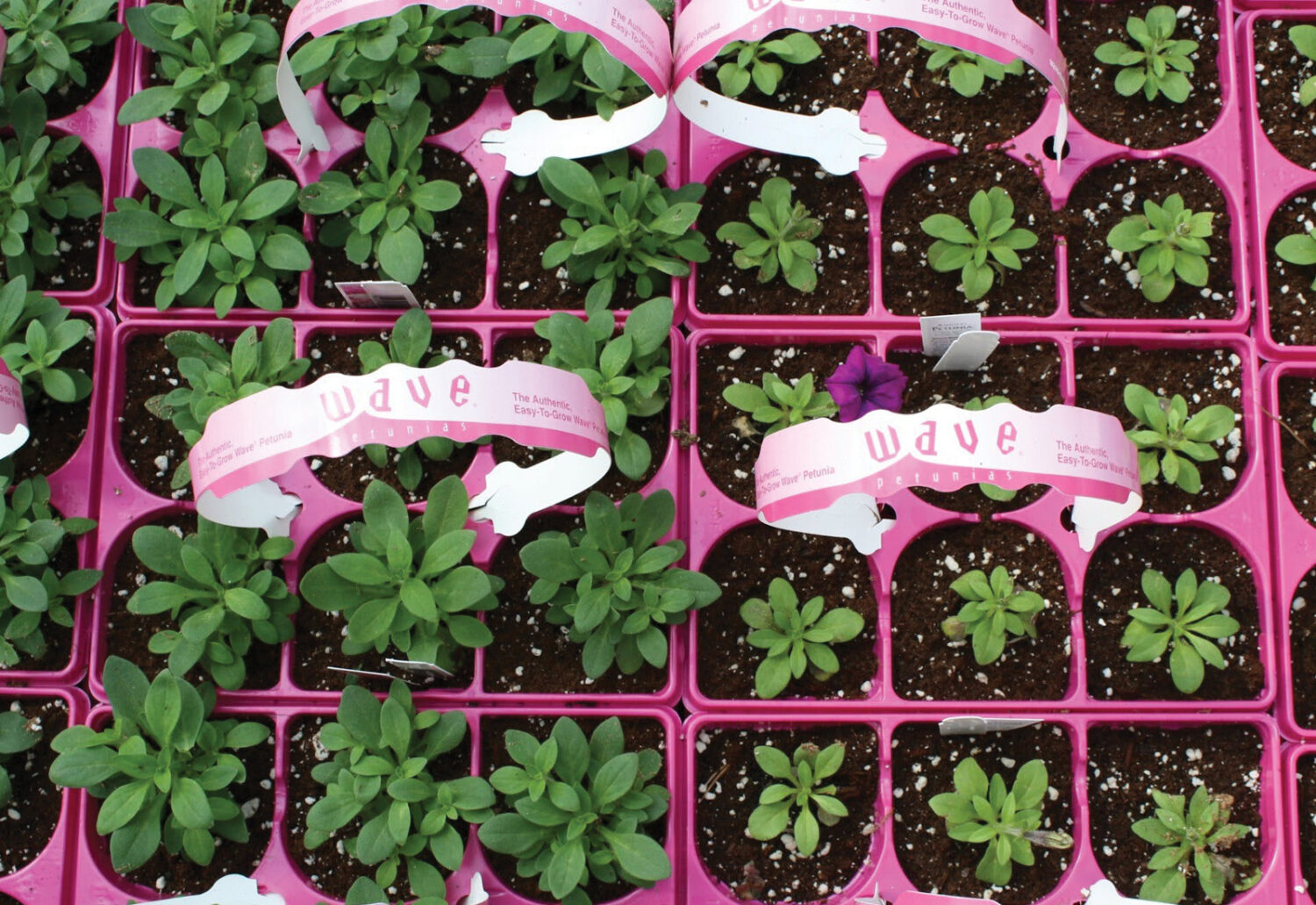
The first and most important step to finish crops on time is putting together a production schedule (Fig. 1). Determining when your plants are going to finish based on the schedule you create, rather than letting crops finish on their own timeline, is key to timely crop production.
Figure 1. At first these petunias don’t look very uniform, until you learn that they are simply two different crops, with the crop on the left scheduled to finish earlier than the crop on the right.
Start with crop notes from past seasons. If you don’t have notes from previous seasons, let this serve as a wake-up call to start. The data specific to your location, environmental conditions and cultural practices will be the most relevant. Aside from any in-house production notes, look for published literature to help schedule crops. Resources like the Ball RedBook and Culture Guide are great resources for production information on a wide variety of crops.
Don’t forget to take advantage of the cultivar-specific technical guides breeders produce for different genetics. Plus, series- and cultivar-specific information from technical sheets and culture guides often provides details not found in more generalized resources like books. Although publications like books and tech sheets may not be specific to your operation, they are a great starting point.
YOUNG PLANT SIZE AND NUMBER
Two primary factors influence the finishing time of spring crops: the size of the starting material (i.e., seedling plugs or rooted cutting liners) and, for larger containers, the number of young plants used in each container. Regardless of whether a young plant is a plug or a liner, the smaller starting material takes longer to finish following transplant.For example, moving from a 288-cell plug to a 128-cell plug can reduce finishing times for the earliest spring crops to reduce their bench time — and heating costs — during the coldest part of the season. Larger plugs may also be useful for quickly producing successive crops for the weeks surrounding Mother’s Day.
For larger containers such as 1-gallon pots, hanging baskets and patio containers, the number of young plants per container also impacts finishing time. Since containers are considered finished when they are flowering and plants are filling in containers proportionally, the relationship between the number of young plants and finishing time are related. As the number of young plants used in a container increases, finishing decreases, and vice versa.
TEMPERATURE
Air temperature can either cause or solve many crop timing issues, as it can be both the “gas” and the “brakes” on crop development, depending on how you manage it.The rate of crop growth and development depends on average daily temperature (ADT), which integrates temperature over a 24-hour period. The base temperature (Tb) is the point at or below which development stops. As air temperature increases above Tb, development rates (i.e. leaf unfolding) increase until reaching the optimal temperature (Topt). As air temperatures increase above Tb, development slows until it reaches the maximum temperature (Tmax), where development stops entirely.
Many growers are tempted to “grow cool” to save on heating costs. While it may be cheaper to heat a cooler greenhouse one on a day-by-day basis, total heating costs often increase when crops are grown cool and take longer to finish. Cooler temperatures slow development rates, extending the time needed for crops to fill containers and flower. Warmer temperatures, when managed correctly, produce finished crops faster.
The cardinal temperatures (Tb, Topt and Tmax) vary across species and cultivars — and because crops range from cold-tolerant to cold-sensitive — fight the temptation to grow too far below Topt, and unnecessarily delay finishing.
FLOWERING CONTROL
In addition to temperature, light also impacts finishing time, especially daylength. The daylength, or photoperiod, influences many plant processes, including flowering (Fig. 2).
Figure 2. While these plants look great, there are no flowers on these petunias that are already the right size for the containers they were grown in.
Long-day plants flower in response to long days and short nights, while short-day plants flower under short days and long, uninterrupted nights. Day-neutral plants flowering regardless of day length. Obligate responses mean flowering occurs only under specific photoperiods, while facultative responses mean flowering happens fastest under inductive photoperiods but still occurs — albeit later — under non inductive photoperiods.
Among bedding plants with photoperiodic flowering responses, most are facultative or obligate long-day plants. Providing as little as 2 µmol·m–2·s–1 at plant height during short days — either before sunrise or after sunset (day extension lighting), or from 10 p.m. until 2 a.m. (night interruption lighting) — is enough to trigger a long-day flowering response.
Short-day flowering responses are less common among spring annuals, but some important crops like marigold and cosmos require them. The only way to create short days is by pulling blackout cloth over the crops to reduce daylength.
PINCHING
Annuals are commonly pinched for a variety of reasons. Pinching can be used to improve appearance and change plant architecture (think begonias), control plant size, or increase branches and speed container fill. Regardless of the reason, it is important to recognize the time (and effort) it takes to mechanically pinch plants and the additional time it takes to finish plants after they’ve been pinched — not to mention the risk of mechanically transmitting diseases.Instead of pinching, consider applying a plant growth regulator (PGR). Apical dominance is controlled by the ratio of auxin to either ethylene or cytokinin. When auxin concentrations are high relative to either ethylene or cytokinin, dominance is maintained. When the concentration of ethylene or cytokinins increases, dominance is released and branching occurs.
While we can spray ethephon (an ethylene-generating PGR), ethylene can also cause flowers to abort — something we want to avoid with spring crops with short schedules. Instead, sprays of benzyladenine (BA), a type of cytokinin, can improve branching without delaying flowering. Spraying BA is also less labor-intensive than pinching.
THE TAKEAWAYS
Shaving just a few days off finishing times doesn’t seem like a big deal — until all the saved days get added up. By creating and sticking to crop schedules, selecting appropriate young plant size and number, carefully managing temperature and daylength, and avoiding mechanical pinching, growers can finish crops on time — and maybe even with time to spare!Photos courtesy of Christopher J. Currey.