

Building a bridge from greenhouse growing to retail success with inputs to maintain crop quality
Learn how growers manage nutrition, plant growth regulators and disease prevention to maintain crop quality from greenhouse production through retail display. See what this means for growers.





Key takeaways
- Nutrient management remains critical during retail display.
- Combining CRF and WSF can support plant quality through retail.
- PGR hold applications are preferred over stop applications.
- Ethylene management helps preserve flowering plant quality.
- Clean crops entering retail reduce pest and disease risks.
- Biological controls can continue providing value during retail.
Spring is the most important time in greenhouses and garden centers, but it can also be the most stressful. Keeping plants cared for and maintaining quality and appearance is not a small task. Here are some tips and tricks for successfully navigating the spring.
NUTRITION
Attractive plants in retail begin with healthy plants free of nutrient deficiencies at the end of greenhouse production. Once plants are sized up and in bud or flowering, maintaining greenness is the primary concern for retailing. For maintaining greenness, magnesium and micronutrients, as well as controlled-release fertilizers (CRF), are great tools to use.
Most producers are using water-soluble fertilizer (WSF) to provide nutrients to plants, as they offer the most flexibility. Instead of using complete, balanced fertilizers when plants are being retailed, you can omit nitrogen, phosphorus and potassium. Magnesium sulfate, or Epsom salt, is the best source for supplemental magnesium. There are WSF such as Soluble Trace Element Mixture (STEM) or Mix of Soluble Traces (MOST) that provide all six micronutrients from boron to zinc.
While most growers rely on WSF, CRF can also be used to produce great crops while potentially providing nutrients during retailing as well. A topdressing of CRF into large containers like hanging baskets when they are set out on display certainly helps keep plants looking good. However, incorporating CRF into production can help provide nutrients during retail and potentially when consumers take the plants home, too.
With release rates ranging from 2 months up to 12 months, there are products that will release nutrients throughout production and through retail — and potentially through the growing season for consumers. As CRF release rates increase, the amount of CRF used to meet needs in production and retail has to increase to make up for the slower release rate.
Fertilizing crops doesn’t have to be an either/or proposition. Instead, using both CRF and WSF at low concentrations (i.e., 1/4 to 1/2 strength) in combination with each other is a great option to meet needs in production and retail, while maintaining the ability to vary the amount of nutrients provided to crops as-needed.
CONTROLLING SIZE
Even if you control crop growth on the bench during production, growth control is also required during retail. The high container density during retail maximizes product for customers, but promotes stretch.
Less-than-ideal weather can reduce sales and keep crops on the bench longer than desired. While strategies like accurate scheduling, cycling plants and minimizing excessive nutrients can control plant size, plant growth regulators (PGRs) are a great tool for controlling growth.
Successful PGRs for retail holding depends on the correct type of application, method of application and active ingredient for application. The type of application affects how growth is controlled. For the end of finishing and retail/display, there are two types of applications: hold and stop. Stop applications should be avoided for spring garden plants, which have a whole growing season ahead of them. Instead, hold applications should be used.
Foliar sprays are the preferred method for applying PGRs to hold crops, since the residual activity of foliar sprays is less than substrate drenches. Finally, select active ingredients with shorter residual activity, such as ancymidol (A-Rest, Abide) and daminozide (B-Nine, Dazide), and avoid those with long residual activity like uniconazole (Concise, Sumagic). Additionally, use low to moderate concentrations that will wear off more quickly.
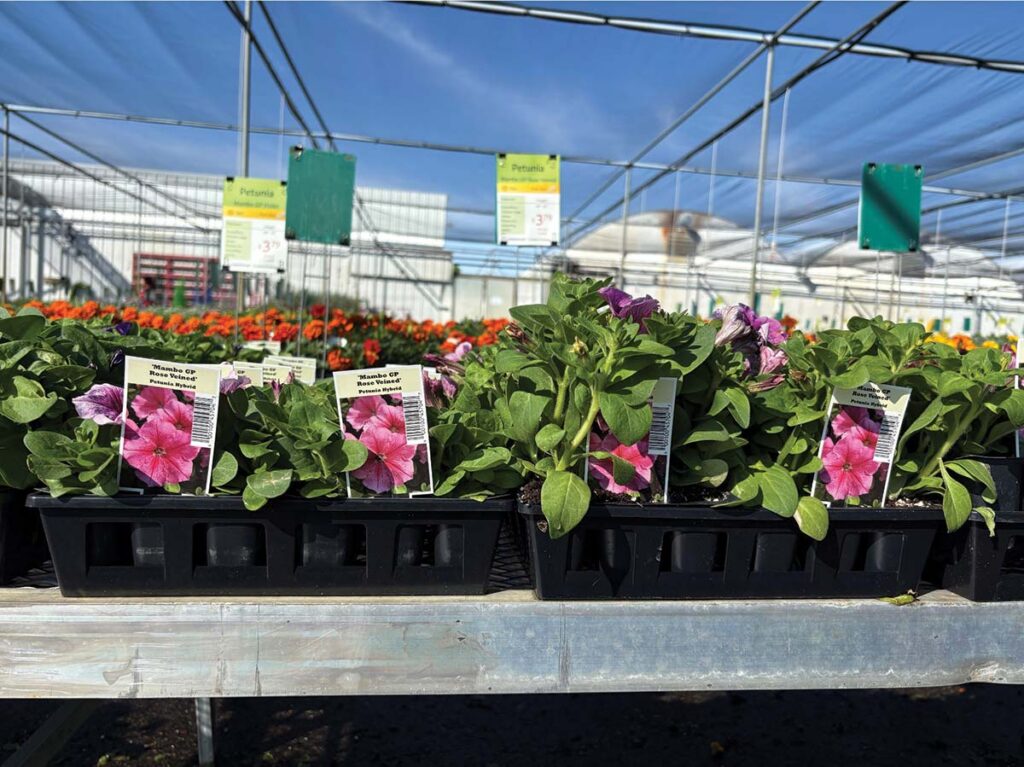
FLOWERING
Flowering annuals are a good thing, but all good things must come to an end. Ethylene is a naturally occurring plant hormone that promotes flower abscission and senescence, which is undesirable on the bench for numerous reasons, from reducing marketability to increasing disease incidence.
There are three primary ways to minimize ethylene damage:
- minimize exposure to ethylene in plants
- minimize ethylene generation in plants
- minimize ethylene sensitivity in plants.
Minimizing the exposure of plants to ethylene can reduce damage, but since ethylene is a naturally occurring hormone, it is produced by actively growing plants. Getting carts off trucks, saran wrap off carts, then plants off racks and onto the bench all help reduce the build-up of and concentrating of naturally produced ethylene. Additionally, when loading and unloading plants onto trucks, don’t delay: engines produce ethylene (diesel and gas producing ~60 ppm and 100 to 200 ppm, respectively).
Minimize ethylene generation within plants is another way to reduce the negative effects of ethylene on flowering. There are two compounds that reduce ethylene synthesis, aminoethoxyvinylglycine (AVG) and aminooxyvinylglycine (AOA), but neither are labeled for bedding plants. While there are no compounds to reduce ethylene generation in bedding plants and perennials, there are some that can minimize ethylene sensitivity.
Chemicals may be applied that can reduce the sensitivity of plants to ethylene. 1-Methylcyclopropene (1-MCP) Ethylbloc and Ethylene Buster (1-MCP) while STS is available as Alesco (STS). Both 1-MCP and STS bind to ethylene receptors and block action. 1-MCP is a powder that, when mixed with water, becomes gaseous and plants must be treated in an enclosed space like the back of a truck, to concentrate the gas around plants for treatment. Alternatively, STS is readily taken up by plants when applied as a foliar spray, and unlike 1-MCP, continues to bind to new ethylene receptors as they develop on plants.
PESTS AND DISEASES
The retail phase is not the time to fight battles with insects and pathogens. Clean crops going into retail is the best start in minimizing problems during retail. However, problems may still arise and management actions may still be warranted in retail. Keep chemical and biological control options on the table.
It is best to avoid sprays when plants are being retailed. First, we don’t want REIs to restrict customer access to plant materials. Additionally, spraying canopies with containers on their closest spacings and highest densities, additional foliage wetness may end up exacerbating diseases like Botrytis. Consider applying a systemic insecticide and fungicide just before retailing. This can provide control during retail without having to treat plants.
Biological control works best when used throughout production and before problems break out, but don’t be shy about using biocontrol in retail. Some growers are using it as an educational opportunity and to add value to their product.
Photos courtesy of Christopher J. Currey.
FAQ
What nutrients are most important during retail display?
Magnesium, micronutrients and controlled-release fertilizers are highlighted as important tools.
Why use both CRF and WSF?
Combining them can provide flexibility while maintaining nutrient availability through retail.
What type of PGR application is recommended for retail holding?
Hold applications are preferred over stop applications.
Why is ethylene a concern during retail?
Ethylene promotes flower abscission and senescence, reducing plant quality and marketability.
How can growers reduce pest and disease issues during retail?
Starting with clean crops and maintaining preventative control strategies helps minimize problems.
Christopher Currey is an associate professor in the department of horticulture at Iowa State University. He can be reached at ccurrey@iastate.edu.