

Growing on a moving target: PGRs, genetics and strategy bring stability back to spring production
Growers are using PGRs, genetics and production strategies to improve timing, quality and predictability in spring crops. Learn how operations adapt and explore key tactics.






Key Takeaways
- PGRs help growers manage timing and maintain crop quality.
- Labor shortages are changing production strategies.
- Data-driven decision-making is becoming increasingly important.
- Production flexibility reduces risk during uncertain sales periods.
- First-year flowering perennials offer scheduling advantages.
- New genetics can improve margins and reduce shrink.
When warm weather arrives, consumers flock to garden centers eager to snap up flowers, shrubs and plants. Most consumers probably don’t realize that taking plants from seed to retail comes with challenges.
“Plant sales live at the intersection of weather, buyer whims, labor constraints, supply chain timing and fast-moving trends,” said Dudley Dabbs, Fine Americas southeastern U.S. sales manager. “Marketing and sales dictate demand, weather dictates timing and growers are left to thread an increasingly tight needle.”
That’s why plant growth stabilizing tools are so essential. They bring predictability back to an otherwise volatile system. Fine Americas’ PGRs help growers better manage crop timing, uniformity and plant quality.
“Height-control PGRs enable growers to slow growth when weather or market delays push sales later, or to fine-tune plant size to meet retail specifications,” said Jim Scruggs, Fine Americas technical services manager. “These work by temporarily inhibiting gibberellic acid biosynthesis, which reduces excessive stem elongation without compromising plant health when applied correctly.”
Fine Americas’ solutions promote improved branching and more compact, finished habits, helping crops present well even when production schedules shift.
“Consistent formulations and clear-use guidelines give growers confidence to adjust rates, timing and application methods to respond to changing conditions inside the greenhouse,” Scruggs said.
The company emphasizes education, stewardship and technical support, which helps growers integrate PGRs more effectively into modern production systems that already rely heavily on environmental controls and data-driven decision-making.
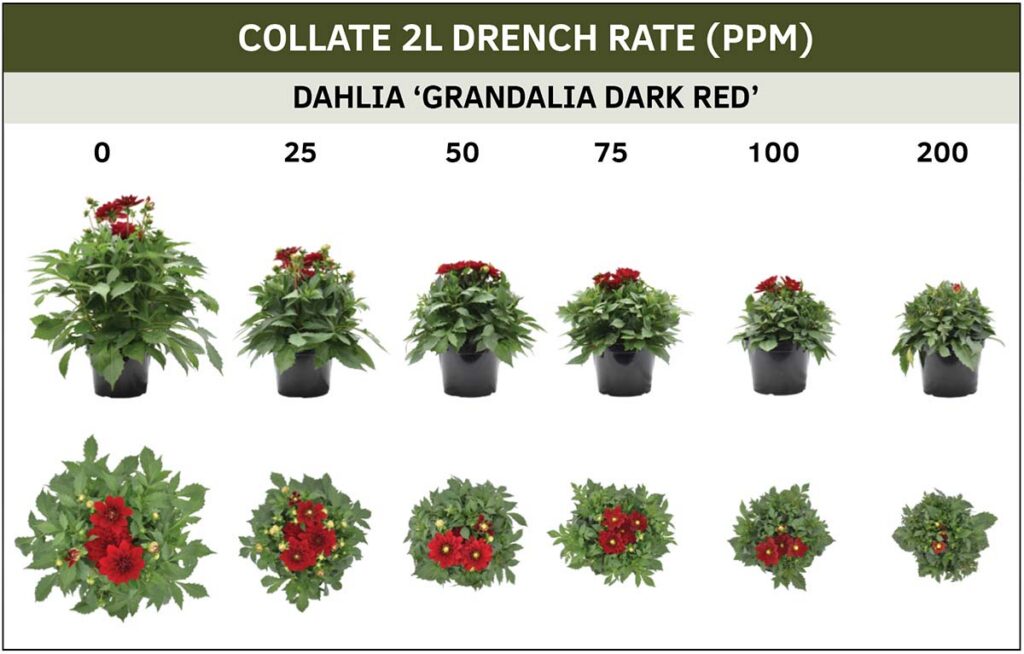
Collate 2L (21.7% ethephon) is approved for substrate drench applications in U.S. greenhouses. “This new use gives growers a more targeted option for regulation while reducing labor inputs by minimizing repeated manual growth-control tasks,” Dabbs said.
Scruggs also mentioned the role of PGRs as a risk-management tool. As growers face unpredictable sales timing, labor shortages and rising costs, PGRs have become a critical safeguard. They help protect labor investments, preserve plant quality during delayed sales windows and reduce shrink or discounting.
When integrated into a broader strategy, PGRs strengthen production resilience by enabling consistency and marketability even when external forces disrupt the original plan. Historically, many operations relied on inexpensive labor and “old-school” approaches to manage growth, but that script has flipped.
With labor no longer cheap or readily available, growers are rethinking how they control crops — which includes shifting away from labor-intensive fixes.
“Segments of the industry that once avoided PGRs are now embracing them as part of a broader modernization of production, recognizing their role in protecting margins, improving predictability and keeping crops retail-ready in an increasingly uncertain market,” Dabbs said.
ON HOLD
A diverse portfolio enables Metrolina Greenhouses to better navigate, manage and spread risk. If one product isn’t performing — whether a color, pot size or a combination — strength in other areas helps offset that impact.
“Building flexibility into production, maintaining real-time visibility in stores and investing in an educated, agile team reduces exposure to negative variables and allows us to respond quickly if conditions change,” said Ivan Tchakarov, Metrolina Greenhouses chief horticulture officer.
His team uses science and business intelligence tools to navigate the market as well as predictive curve software and historical analytics to ensure products are up to spec and on time.
“If we must hold them, we have the tools to deliver a quality product and manage lower waste targets,” Tchakarov said.
Sometimes holding plants is the only option. When necessary, the technical team at Dümmen Orange recommends lowering day and night temperatures. Cold-sensitive species should be kept between 55° F and 60° F; cold-tolerant between 45° F and 50° F. Growers can also lower day and night temperatures to prevent stretching.
Other tips include watching humidity levels, keeping plants on the dry side and maintaining good air movement. Spray or lightly sprench plants that will be transplanted into garden beds or containers and drench plants in final containers. Finally, use PGRs with short residual and follow all label rates.
PERENNIAL POWER
Innovations in breeding for first-year-flowering perennials have changed production from a process dominated by biological requirements to one that enables growers to rethink scheduling and overall program strategy. The retailer’s perspective has also shifted from variety specific shopping to selecting plants that are in bloom when they arrive.
They can be propagated, finished and ready for retail within a single growing season, without the need for cold exposure. This enables growers to produce finished, flowering plants from unrooted cuttings or liners the same year they’re planted.
It also allows for skipping vernalization. For some genera, it’s necessary for developing the crown and roots; for others, it’s the biological mechanism that triggers flowering in spring or summer. While effective, the cold requirement extends production timelines and increases exposure to risk.
Labor efficiency is another perk. Single-season production reduces handling. First year flowering selections also elevate crop quality since multiple production runs enable the delivery of fresh, peak-color plants.
“Taking advantage of the new genetics being launched can have a positive impact on the bottom line by improving margins and increasing the opportunity to reduce shrink,” said Katie Miller, Dümmen Orange product manager for perennials.
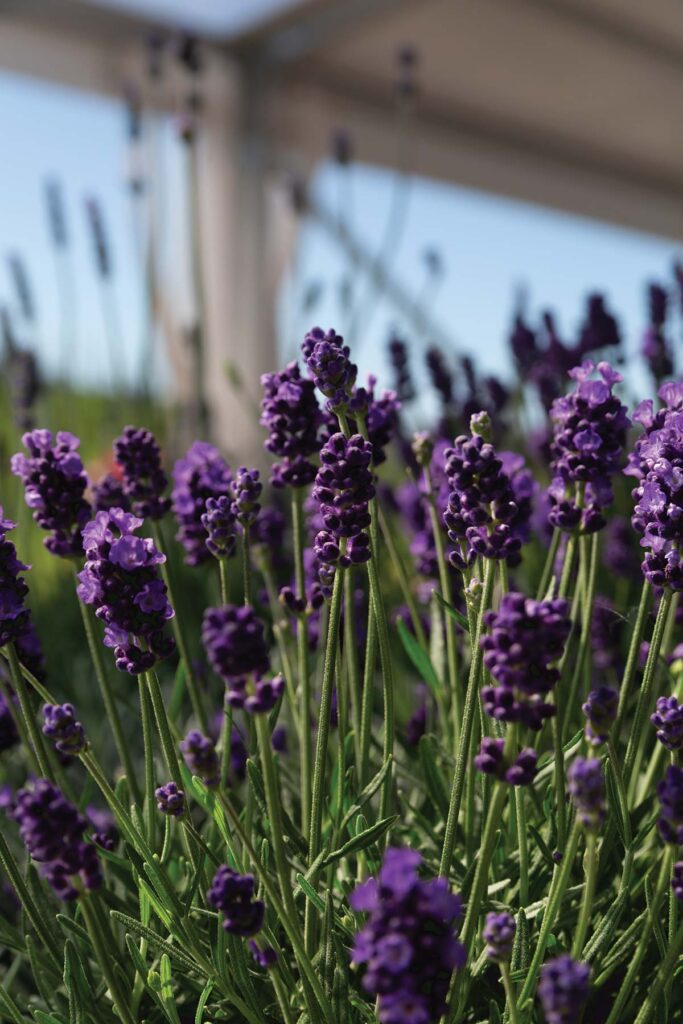
Consider the Lavandula angustifolia La Diva Eternal series.
“What has traditionally been a challenging crop that requires being planted in the fall and wintered over has been reduced to a 16-to-18-week schedule for a 6-inch pot from stick to ship when grown above 50° F,” Miller said.
Now, instead of one or two large crops that are limited by the life of their flowers or that require a cutback to be re-flushed, growers can produce multiple crops of fresh plants that can be started throughout the year, changing the accessibility of lavender.
Regina Molaro is a freelance editor whose work has been featured in more than 20 publications. She can be contacted at reginamolarofreelance@gmail.com.