

Culture Report: Hydrangea Game Changer Series
The world’s first daylength-neutral hydrangea saves months of crop time, delivering incredible flowers in just 14 weeks from URC!





Traditionally, hydrangea production occurs from dormant liners that are forced to meet the desired bloom schedule. These dormant liners are not only costly, but they still require 12 to 14 weeks to initiate flowers depending on the temperature. The Game Changer series will boast large lace cap flowers in 14 weeks from unrooted cutting.
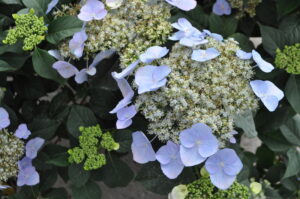
This never-before-seen attribute does not only save months of crop time but allows year-round scheduling for finished sales. Hydrangea color can be available for all retail seasons without the need for coolers to hold the product.
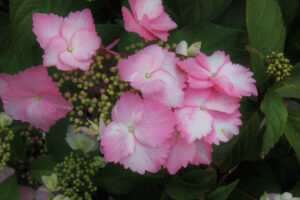
The Game Changer series fits perfectly into the Green Fuse Botanicals First Light perennial program because production schedules are based on growing temperature and not daylength or vernalization requirements. The Zone 5 hardiness enables sales as a perennial or woody in addition to the potted floral plant market. With four colors available — Blue, Pink, Shell Pink and Picotee — you are able to deliver a wide assortment consistently.
Unrooted Cutting Rooting
The unrooted cuttings will arrive as double node. A cell size of 25 to 30 mm is sufficient. A hormone dip is beneficial or a K-IBA foliar application at the rate of 350 ppm. Bench heat of 70 to 72° F. Mist feed is advised at a rate of 50- to 65-ppm nitrogen. Root emergence will occur day 14 to 16 and may then be moved from bench to hardening and held at 60 to 65° F.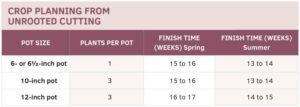
Transplant Temperature Requirement
Recommended temperature is 68 to 72° F days and 60 to 65° F nights.Cooler nights once established enhances finished quality. Game Changer is hardy to Zone 5. These hydrangea will continuously flower all spring and summer in containers and landscape the first year of production from stock.
Fertilization
While hydrangeas are heavy feeders, they can be damaged with too much feed in the early stages of development. Normally, one application of 20-20-20 at the rate of 250 ppm will suffice. For Pink varieties, high levels of phosphorus and low levels of potassium are required; aluminum is less available with this ratio. The pH level needs to be maintained between 5.8 to 6.2.For all colors, a constant fertilization of 20-10-20 can be applied at a rate of 100 to 150 ppm. For ‘Game Changer Blue’, apply aluminum sulfate at the rate of 7½ pounds per 100 gallons of water weekly for three weeks at time of flower initiation. This is to be done approximately three times to insure a good blue color. Drench only the growing media with this solution.
Avoid getting any aluminum sulfate on the leaves or damage will occur; immediately wash off the leaves if the aluminum sulfate gets on them.
As with fertilization, never apply aluminum sulfate to a dry root ball because it will burn the root hairs. Aluminum sulfate will help lower the pH; maintain blue pH between 5.0 to 5.5. Blue is a light feeder that will need high potassium and low phosphorous levels to keep the aluminum available to the plants. If the root hairs are damaged or the pH is too high, interveinal chlorosis can occur. Leach the root ball thoroughly two to three times, then start reforming the root hairs. The chlorosis will disappear, and health green leaves will start forming. To reduce the pH, apply an acid forming fertilizer and/or inject the water with phosphoric acid.
Pinching Requirements
It is recommended to pinch at time of transplant.Growth Regulators
Apply B-Nine at a rate of 2,500 to 3,500 ppm. A paclobutrazol drench may also be applied post flower initiation at a rate of 2 to 3 ppm. This will hold the plant without noticeable flower size decrease.Jim Devereux is vice president of Green Fuse Botanicals. He can be reached at jdevereux@green-fuse.com.