







Real-world ROI of greenhouse automation
Automation can decrease labor and costs, and increase productivity and profit throughout your business. Starting with small changes can turn into big improvements. Let’s take a look at what some growers are using in their greenhouses today to stay up to date with innovation and continue growing into the future.
AN INVESTMENT
Catoctin Mountain Growers maintains a long-term mindset when making big business decisions. As a large grower of annuals, perennials, mums and poinsettias, Catoctin is always looking forward to the latest technology and strategies to keep business thriving. The business started as a 1-acre operation in 1985 and has grown into 23 acres indoors and 15 acres of outdoor production today; keeping up with innovations was always a key component in decisions.
Tyler Van Wingerden, vice president of Catoctin Mountain Growers, said, “Financially, you have to put more money up front, but year in and year out, labor only goes up, cost of plants only goes up. All those things are always increasing and becoming more difficult. So, we try to build in as much efficiency in the capital side when we’re building a project. That way those continuing costs that are always going up are staying within a facility that is high-quality and future proof.”
MAKING A SHIFT
“I want to augment the talent that I have,” Van Wingerden said. While automation has an effect on labor, Van Wingerden thinks of automation as a way to add value to existing labor that already exists.
“I’m not firing the existing team members,” he said, “but when I add 2 acres or 5 acres, my team of 70 can still be a team of 70. I have 70 people taking care of 5 more acres of greenhouse because automation augments their abilities. It allows them to do more, it allows them to grow more, it allows them to produce more.”
Catoctin is working on better technologies for the growing department. Irrigation can be a big time sink every day because of the mundane tasks associated with it, like turning on faucets or hand watering crops.
Innovation in this area of the greenhouse will help expand workers’ ability and give the growers time to improve other crucial skills they have, he said.
INCREASING PRODUCTION
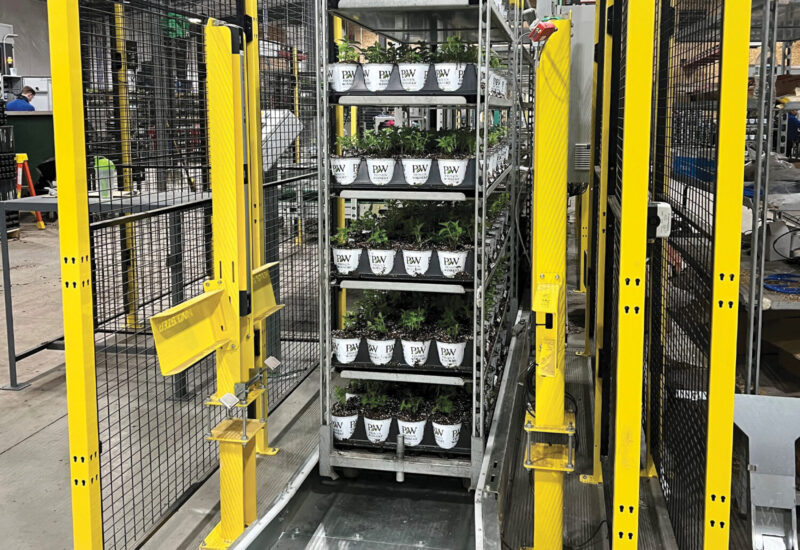
Spring Meadow Nursery implemented automation on one of its production lines starting at the beginning of 2022. This reduced the need for one employee per machine and increased its production by up to 30 trays per person per hour.
A recent innovation is the Visser cart loaders, said Summer Field, propagation manager at Spring Meadow Nursery.
The benefits were so good that Spring Meadow bought two more cart loaders this year and put them on other production lines; now three of the four production lines are putting out more trays daily.
“Not only does it allow us to remove an operator off the line, it also allows us to add an additional shelf onto that cart, to haul plants out into our production facility,” Field said. This decreases labor costs and increases rates and timing on each production line. Being able to add an additional shelf on each cart gives an additional five flats per cart.
Previously, Spring Meadow Nursery installed other innovative technology like soil filling machines and a TTA transplanter machine in its production setup. All of the automation working together can provide up to 210 more trays per hour than what was being produced in years past without it.
“At our peak, I would say just two transplant lines can produce about 30,000 flats a week easily, ” Field said.

TRYING NEW TECHNOLOGY
Catoctin Mountain Growers has partnered with IUNU, an artificial intelligence and industrial computer vision company located in Seattle.
IUNU’s camera system was installed in an acre of the greenhouse to monitor growth rates, germination, plant health and inventory tracking.
The second project focuses more on greenhouse energy usage with the University of Maryland to optimize energy consumption within manufacturing facilities. Upgrading lighting and making the LEDs “smarter;” measuring heat circulation and how to capture natural heat to reduce the use of supplemental heat; and measuring water flow with meters to investigate how the amount of water used correlates with variables like sunlight, temperature and humidity.
“If we have this computer intelligence helping to make decisions that help my team have more freedom to be creative or oversee things at a higher level, I think that I’ll probably get better innovation from my growers,” Van Wingerden said.

 Video Library
Latest News
NGB announces 2026 Green Thumb Award Winners
Coleus named 2025-26 Flower of the Year in Japan