






Understanding How PGRs Work
Plant growth regulators are chemical compounds that regulate various growth and developmental processes in plants, such as seed germination, rooting, branching, flowering, fruit development, dormancy and plant growth habit. As the name implies, plant growth retardants (PGRs) are a specific type of plant growth regulator that inhibit subsequent extension growth and thus, make plants more compact. PGR applications are commonly applied on a wide range of ornamental crops, especially floriculture crops, so that plant size is more appropriate for its container, meets market height specifications, or both.
In the United States, there are quite a few PGRs registered for use on ornamental crops (some of these cannot be used in Europe, for example, because of human health concerns). The potency of PGRs depends on a number of factors including the active ingredient, concentration and volume applied, method of application, environmental conditions (such as temperature, light and humidity) and, of course, the crop. Something all PGRs have in common is that they inhibit various steps in the biosynthetic pathway of gibberellins (often collectively referred to as gibberellic acid, or GA).
GA is a family of plant hormones produced naturally by plants, fungi and other microorganisms. At low concentrations (whether produced naturally or applied to the crop), GA promotes extension growth and thus, increases plant height. The biosynthesis of GA by plants is a very complex, multi-step process that varies somewhat from one species to another. There are at least 125 different types of GA, although most are considered inactive. Generally, the active GAs are GA1, GA₃, GA₄, and GA₇. Products containing GA₃ (such as ProGibb T&O and FlorGib) or GA₄₊₇ (such as Fresco and Fascination) are registered for use on ornamentals to increase plant height or perform another function.
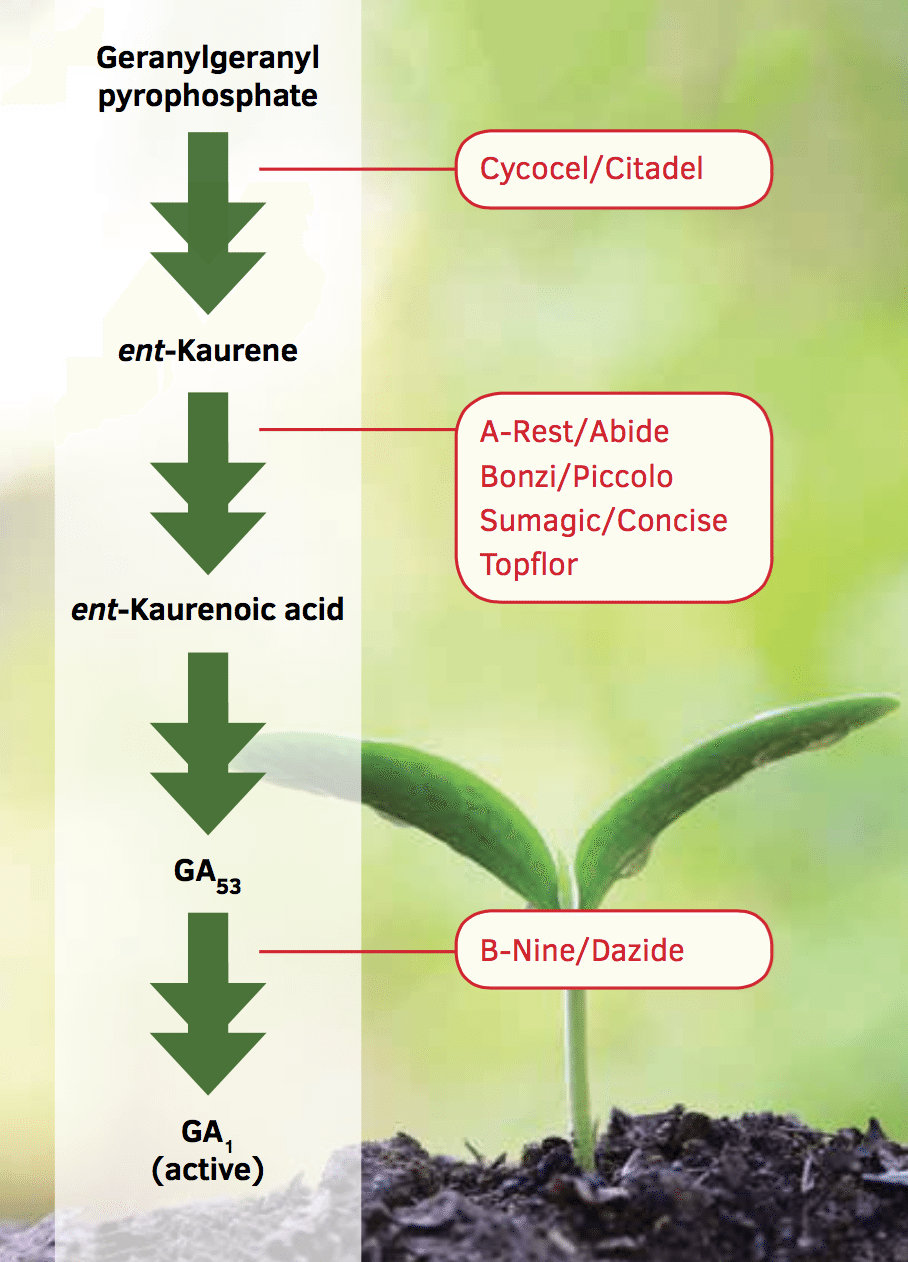
In the multi-step biosynthesis of active GAs, there are various enzymes that promote the conversion of one compound into another. PGRs commonly used on ornamentals inhibit one or more specific steps in these compound conversions, which ultimately lead to less production of active GAs, such as GA₁ (Figure 1). Some compounds inhibit early steps in GA biosynthesis whereas others inhibit late steps. Interestingly, the more potent PGRs, such as Bonzi/Piccolo and Sumagic/ Concise, inhibit similar GA conversion steps.
To complicate things, plant hormones interact with each other to regulate plant growth and development, although the nature of this interaction is also complex and in some instances, is not well understood. There is evidence that ethylene regulates the action of GA. Ethephon, which is the active ingredient in Florel/Collate, releases ethylene and can also act as a PGR. However, it is not a specific inhibitor of GA biosynthesis and thus, these chemicals are not included in Figure 1.
Daminozide (e.g., B-Nine and Dazide) acts very late in the GA biosynthetic pathway. In at least some plants, ent-Kaurenoic acid can be converted to GA₄, which is also an active compound. In contrast, the other products block earlier steps in the pathway and thus, inhibit biosynthesis of all biologically active GAs.
While PGRs can inhibit GA biosynthesis, GA compounds applied to plants cannot be subsequently inhibited by PGRs. Products such as Fascination, Fresco, ProGibb T&O and FlorGib deliver active GAs and so the PGRs have no effect, since they act only in the conversion process to active forms of GA. Therefore, while a PGR overdose can be overcome by GA application, a GA overdose cannot be overcome by a PGR application.
Erik Runkle is professor and floriculture extension specialist in the department of horticulture at Michigan State University. He can be reached at runkleer@msu.edu.
 Video Library
Latest News
see all news »