








Mealybug management: Have we reached an impasse?
Answer: A waxy coating, quick reproduction and overlapping generations can make control tough.
Mealybugs are one of the most challenging insect pests to manage in greenhouse production systems. The female mealybug life cycle consists of five stages: an egg, three nymphal stages and an adult. The male mealybug life cycle consists of six stages, including two pupal stages: prepupa and pupa. The life cycle takes 25 to 60 days to complete, depending on temperature and host plant.
Mealybugs feed in the phloem (food conducting tissue of plant) with their piercing-sucking mouthparts. During feeding, they excrete honeydew, a clear, sticky liquid that attracts ants and serves as a substrate for black sooty mold.
Extensive infestations of mealybugs may result in plant wilting, stunted plant growth, leaf chlorosis, leaf drop, premature flower or fruit abortion and/or plant death. Mealybugs feed on a wide range of greenhouse crops, including begonia, chrysanthemum, coleus, croton, marigold, poinsettia, pothos and transvaal daisy.
NON-INSECTICIDAL STRATEGIES
The non-insecticidal strategies of managing mealybug populations are associated with sanitation and fertility.
- Immediately dispose of plants that are heavily infested with nymphs and egg laying females. Plants already infested will spread to other plants in the greenhouse.
- Remove weeds from within and around the greenhouse perimeter because some may harbor mealybug populations.
- Avoid applying excessive concentrations of water- soluble, nitrogen-based fertilizers because female mealybugs feeding on plants with a high nitrogen content produce more eggs than normal.
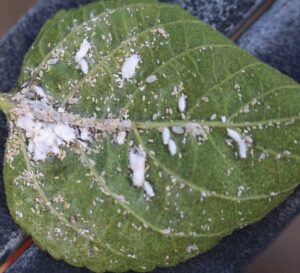
Figure 1

Figure 2
INSECTICIDAL STRATEGIES
Insecticides are primarily used to manage mealybug populations below plant-damage levels. However, there are several biological factors described below that contribute to mealybugs being difficult to manage with insecticides in greenhouse production systems.
- Mealybugs feed on leaf undersides (Figures 1 and 2), stems (Figure 3) and the base of plants (Figure 4), which obscures detection or visual observations, reduces exposure from applications of contact insecticides and minimizes attack from biological control agents.
- Young nymphs are difficult to detect because of size and ability to conceal on plants by feeding on stems and plant bases.
- Mature nymphs and adults have a waxy (hydrophobic) covering that prevents insecticides from contacting the cuticle (skin) and penetrating into the body.
- Mealybug females can lay over 400 eggs during their lifespan. Therefore, it is important to kill females with contact insecticides before eggs are laid.

Figure 3

Figure 4
ENHANCE CONTACT INSECTICIDES
Apply contact insecticides when young nymphs are present because they do not have a waxy covering.
- When applying, thoroughly cover all plant parts, including leaves (topside and underside), stems and base of plants. High-volume insecticide applications that result in thorough coverage of all plant parts can lead to high mortality of mealybugs.
- Apply contact insecticides within timely intervals (e.g., once or twice per week) to kill females before they lay eggs.
However, application intervals are dependent on the residual activity of a given contact insecticide. Consequently, read the label for information associated with frequency of application. Repeat or multiple applications will be required because the nymphs do not emerge (eclose) from eggs simultaneously, with emergence occurring over an extended period.
Apply insecticides frequently when overlapping generations and mixed life stages (eggs, nymphs and adults) are present simultaneously. More frequent insecticide applications typically lead to high mealybug mortality.
- Rotate insecticides with different modes of action to mitigate the prospect of resistance developing in populations.
- Systemic insecticides are not effective in managing citrus mealybug, Planococcus citri, when applied as a drench or granule to the growing medium. Although mealybugs feed in the phloem sieve tubes like aphids and whiteflies, they feed differently, which may affect their ability to ingest lethal concentrations of the systemic insecticide active ingredient.
FACTORS THAT CONTRIBUTE TO POOR MANAGEMENT
- Not regularly inspecting greenhouse grown horticultural plants, especially plants that are susceptible to mealybugs.
- Not thoroughly covering all plant parts with spray applications of contact insecticides.
- Not applying contact insecticides when young nymphs are present.
- Not applying contact insecticides frequently enough, which leads to overlapping generations with different life stages (eggs, nymphs and adult females) present simultaneously.
- Not disposing of old plant material (e.g., pet plants) harboring mealybug populations that can move onto the main greenhouse grown crops.
For information on the management of mealybugs in greenhouses and interiorscapes, refer to the following publication: Cloyd, R. A. 2011. Mealybug management in greenhouses and interiorscapes. Kansas State University Agricultural Experiment Station and Cooperative Extension Service; Manhattan, Kansas. MF-3001. 4 pages.
Photos courtesy of Raymond A. Cloyd.

 Video Library

Latest News
Seed Your Future releases 2025 career lessons
Indoor Ag-Con sets 2026 finance keynote