







Bioinsecticide built for real-world greenhouse programs
In a recent interview with Carlos Bográn, director of technical services for BioWorks, I learned the important details of what sets PRINCIPLE WP apart from other bioinsecticides on the market, and why BioWorks saw an opportunity to improve formulation performance, compatibility and crop aesthetics.
With increasing regulatory pressure and growing interest in effective biological control options for greenhouse operations, this conversation explores how PRINCIPLE WP delivers broad-spectrum control, cleaner applications and conventional-level performance for greenhouse, ornamental and field-grown crop producers.
GPN: Please briefly tell us what PRINCIPLE WP is.
Carlos Bográn: PRINCIPLE WP is a biological insecticide, or bioinsecticide, designed to manage and control pests that damage ornamental, greenhouse and field-grown crops.
GPN: What prompted BioWorks to develop this bioinsecticide?
Bográn: With more than 20 years of experience working with Beauveria bassiana bioinsecticides, we recognized the opportunity to engineer a formulation that mixes and applies more easily, delivers conventional level performance and compatibility, and minimizes visible residue on treated crops.
The active ingredient is a selected strain of a beneficial fungus, Beauveria bassiana. It’s an entomopathogenic fungus commonly found in native soils worldwide that causes diseases, including the white muscardine disease in infected insect hosts. This fungus has been widely utilized in agriculture as a bioinsecticide, with most products containing the fungal spores (conidia).
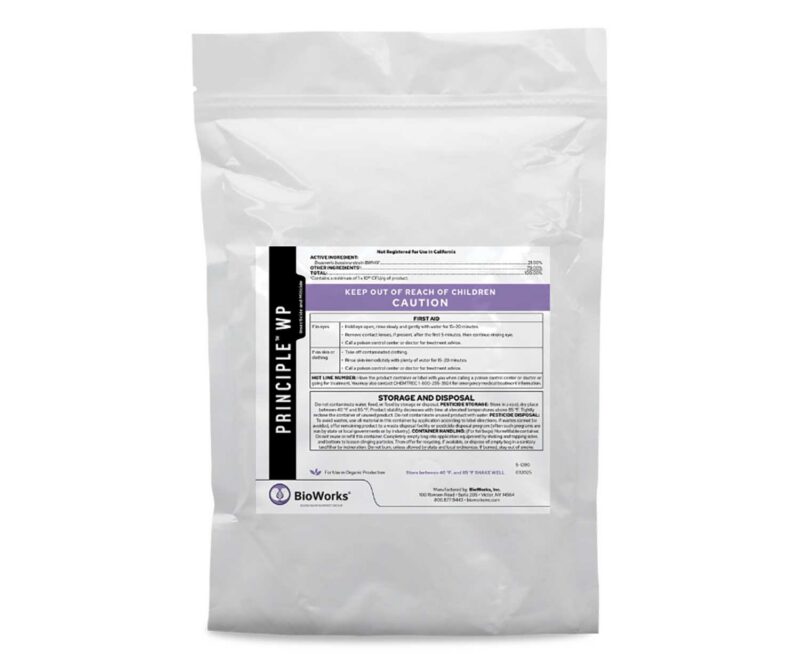 GPN: How is PRINCIPLE WP different from other Beauveria bassiana products?
Bográn: PRINCIPLE leverages decades of expertise in the selection, development and application of Beauveria bassiana technologies. This formulation has improved solubility and significantly reduced residue, ensuring more efficient application and cleaner crop surfaces, which are better for market-ready plants.
GPN: What insects does it control? And what crops is it labeled for?
Bográn: Labeled for management of thrips, whiteflies, aphids, mealybugs, diamondback month, cabbage loopers and other damaging insects, it is considered a broad spectrum insecticide, especially against soft-bodied, immature stages of insect pests.
GPN: Is PRINCIPLE WP compatible with other products in tank mixes?
Bográn: PRINCIPLE WP demonstrates broad tank-mix compatibility with a wide range of crop protection products, including biologicals, conventional chemistries and nutrient solutions. When integrating it into spray programs, you can always conduct a jar test to confirm physical compatibility and maintain agitation during mixing and application.
GPN: What are some of the specific research results you have seen with PRINCIPLE WP?
Bográn: Extensive trialing of PRINCIPLE WP has demonstrated its effectiveness and plant safety in a diverse range of crop settings.
In a widely available Whitefly trial, PRINCIPLE WP delivered 9% greater control of whitefly nymphs than a competitive B. bassiana product and 56% greater control than a competitor Isaria fumosorosea product. In this evaluation:
- Both low and high application rates of PRINCIPLE WP significantly reduced whitefly nymphs
- PRINCIPLE WP provided efficacy statistically similar to the chemical standard Spirotetramat
- No plant phytotoxicity was observed during the study Additional trial data can be found at bioworksinc.com/ ask-us/#knowledgebase.
GPN: Is there a concern about resistance to PRINCIPLE WP?
Bográn: Bioinsecticides have multiple and complex modes of action. Pest mortality is caused by a disease process and not by exposure to a single mode of action. This minimizes the risk of insecticide resistance development, relative to that of synthetic insecticides with single mode of action. PRINCIPLE’s complex mode of action provides control with no risk of resistance.
GPN: Can biological control be as effective as conventional programs?
Bográn: Yes, biological control can be as effective for growers who are fully committed but bioinsecticides also provide benefits to conventional growers that are looking for alternatives to broad spectrum synthetic insecticides under regulatory pressure.
Photos courtesy of BioWorks.

 Video Library